Ferrari: The Luxury House That Happens to Make Cars
By The Intelligence Edge Research Team · July 10, 2026 · 60 min read
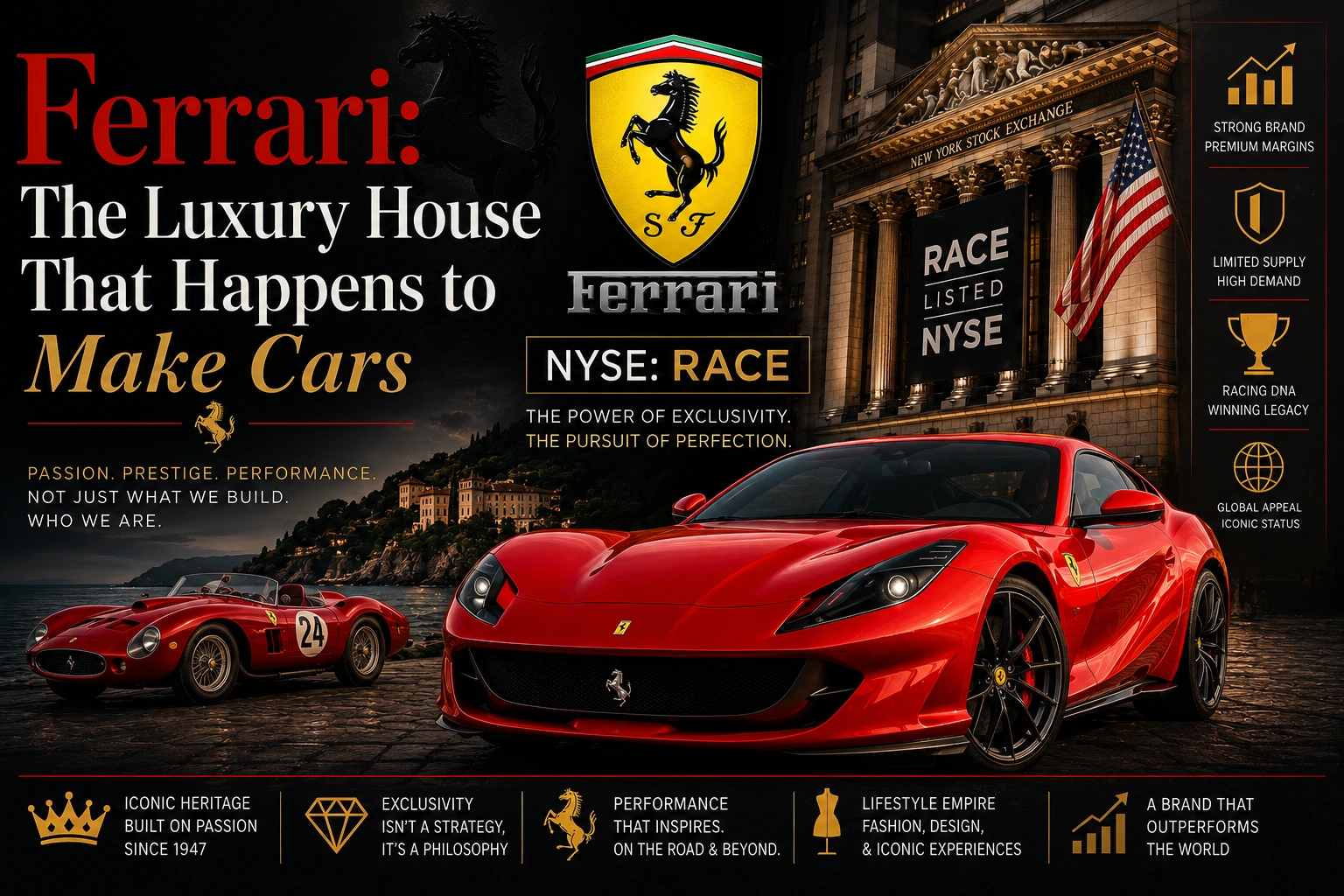
Ferrari sold fewer cars in 2025, but revenue rose anyway. We map the scarcity machine behind it, and price what the ~€355 share already assumes
Ferrari sold fewer cars in 2025 than the year before, and revenue went up anyway. This is the initiation of coverage that explains why — the history, the business model, the economics of desire, and six years of audited numbers, before we put a price on any of it.
A genuinely exceptional business, priced for its excellence.
Quality without a margin of safety. This initiation is a map of the debate, not a buy-or-sell call — we frame the risk/reward and leave the decision, and the holding period, with you.
- BullA one-of-a-kind luxury compounder with a 96-year moat; over a long horizon, a fair price for an exceptional business beats a cheap price for a mediocre one.
- BaseOn conventional assumptions (~12% free-cash-flow growth fading to 7%, 8% WACC), intrinsic value is about €285 — below the ~€355 the market pays.
- BearAt a mid-30s P/E the price already underwrites a decade of mid-teens compounding; priced for perfection, it punishes the first genuine stumble.
Executive Summary
In 2025 Ferrari shipped 13,640 cars — 112 fewer than the year before — and still grew revenue 7% to €7.15 billion, kept 29.5 cents of every sales euro as operating profit, earned €1.6 billion of net profit and produced a return on equity of roughly 43%. No mass automaker comes anywhere near those numbers. Several great luxury houses do. That is the whole thesis in one paragraph: Ferrari is a luxury house that happens to make cars.
The mechanism is engineered scarcity. Ferrari deliberately builds fewer cars than its customers demand — the order book already stretches into late 2027 — so price, mix and personalization do the growing instead of volume. Revenue per car has climbed from roughly €311,000 in 2020 to about €440,000 in 2025, and because the extra revenue arrives without extra factory output, margins widen the whole way down the income statement.
What follows explains the machine: the history and governance that built the doctrine, the interlocking business model that enforces it, and the luxury economics — Veblen dynamics, scarcity held as an asset, a self-renewing ultra-wealthy customer base — that make it durable. We then audit the results across FY2020–FY2025, every figure sourced to Ferrari's own filings: revenue more than doubled on essentially flat volume, net industrial debt eliminated, €1.5 billion of industrial free cash flow, a new ~€3.5 billion buyback and a dividend payout target raised to 40%. What this instalment deliberately does not do is price the shares — Ferrari trades at luxury-house multiples far above any mass automaker, and whether those multiples are justified is the subject of the valuation section that follows this one.
- Growth without volume. Revenue more than doubled from €3.46bn (2020) to €7.15bn (2025) while deliveries rose only from 9,119 to 13,640 — and actually fell in 2025. The growth engine is price and mix, not the assembly line.
- €440,000 per car and rising. Average revenue per car is up 42% in five years, powered by a large and very high-margin personalization business layered on top of every sale.
- Luxury-house profitability. A 29.5% operating margin, 38.8% EBITDA margin and ~43% return on equity — economics that belong in the same sentence as Hermès, not Ford.
- A fortress balance sheet that pays out. €1,535M of industrial free cash flow in 2025, net industrial debt essentially eliminated, and customer deposits arriving years before cars are built.
- Rising capital returns. A €2bn buyback completed a year early; a new ~€3.5bn programme announced for 2026–2030; the dividend payout target lifted from 35% to 40% of adjusted net profit.
- Stable, long-horizon ownership. Exor (~21–24% economic, ~32% voting) and the Piero Ferrari trust (~10.7%) anchor the register — governance that thinks in decades, not quarters.
The Category Error at the Heart of Ferrari
The world's most famous carmaker makes no sense as a carmaker — and nearly everything confusing about the stock follows from that one filing mistake.
Every index provider, screening tool and casual observer puts Ferrari N.V. in the same bucket as Toyota, Volkswagen and Ford. Judged inside that bucket, nothing about the company adds up. Its 2025 operating margin of 29.5% is a multiple of what even a well-run mass automaker earns. Its annual output — 13,640 cars — is a rounding error next to the millions of vehicles a volume manufacturer ships. And yet the stock market values Ferrari above Ford, a company that sells vastly more cars every year. Strangest of all: in 2025 Ferrari delivered fewer cars than in 2024, and revenue went up.
Every one of those apparent absurdities dissolves the moment you change the filing. Compare Ferrari to Hermès, LVMH or Richemont instead of to carmakers, and the picture snaps into focus: a house that sells scarce, hand-finished objects of desire to the world's wealthiest people, at prices set by exclusivity rather than by competition, with a waiting list measured in years. The margins stop being impossible. The falling-volume, rising-revenue year stops being a paradox and becomes the business model working exactly as designed.
Ferrari is a luxury house that happens to make cars. Every number in this report is downstream of that sentence.
This initiation builds the case from the ground up: the story — how a racing stable founded in 1929 became an independent New York-listed company, and why its governance still protects the founder's doctrine; the business model — the deliberate underproduction, the personalization machine, the product ladder, Formula 1 as a permanent marketing engine, and a distribution network kept small on purpose; the economic theory — why demand for a Ferrari rises with its price, and what that does to a profit-and-loss account; and finally, six years of audited financials, every figure traced to Ferrari's own Annual Reports and Form 20-F filings.
What we will not do here is issue a recommendation or a price target. Ferrari trades at valuation multiples far above any mass automaker — luxury-house multiples — and whether that premium is deserved is a question we quantify separately, later in this report. The job of this instalment is different: to make the machine legible, so that when the valuation debate arrives, you can judge it on the economics rather than the badge.
Racing First: How a Stable in Maranello Became a New York Blue Chip
Seventy-eight years from Enzo's Scuderia to an independent listed company — and why its owners still think in decades.
The Reluctant Carmaker
Ferrari began as a racing team. The cars came later, and mostly to pay for the racing.
Enzo Ferrari founded Scuderia Ferrari in 1929 as a racing team — a full eighteen years before he established the road-car company in Maranello, Italy, in 1947. Even then, the road cars existed largely to fund the racing. Enzo saw himself as a constructor of racing machines who sold cars to customers because the Scuderia needed the money.
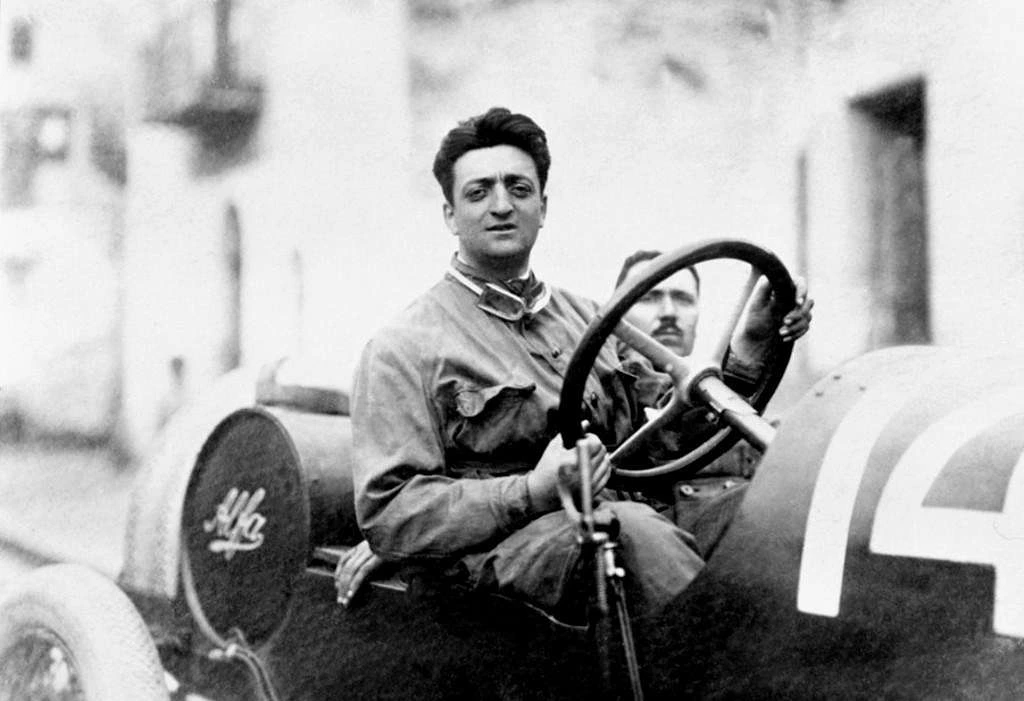
That inversion is the foundation of everything the modern company monetizes. Nearly every other manufacturer goes racing to help sell cars; Ferrari sold cars so it could keep racing. Authenticity of that kind cannot be bought, licensed or reverse-engineered — a rival could match Ferrari's engineering long before it could match its story. When we later treat "brand equity" as an economic asset, this is where the asset was accumulated: three-quarters of a century of it, one race at a time.
The origin also explains the founder's most quoted commercial instinct: always build one car fewer than the market demands. Enzo rationed his customers as a matter of temperament long before anyone framed it as strategy. The modern, NYSE-listed Ferrari has professionalized that instinct into a production doctrine — but it did not invent it.
The Fiat Decades
Half a century inside a giant — protected, but mispriced.
For most of its corporate life Ferrari lived inside the Fiat empire. Fiat took a 50% stake in 1969, deepened it over the decades, and carried Ferrari through the Fiat Chrysler (FCA) era as the group's crown jewel. Enzo remained the animating presence until his death in 1988, and his son Piero Ferrari kept — and still keeps — a meaningful family holding, a living thread back to the founder.
The arrangement gave Ferrari the industrial backing of a giant while ring-fencing the brand from the compromises of mass production. But it created a quieter problem: buried inside a sprawling volume carmaker, Ferrari's extraordinary economics were invisible to investors. The market priced the conglomerate; it could not price the jewel. Someone eventually noticed the gap.
Marchionne's Arbitrage
"Value over volume" — the doctrine that built the modern investment case.
That someone was Sergio Marchionne, the FCA chief executive who understood that Ferrari inside FCA was a luxury asset trapped at automaker prices. His answer was surgical: an initial public offering on the New York Stock Exchange in October 2015, followed by a full spin-off from FCA in early 2016. Even the ticker — RACE — was a statement about what was being sold.
Marchionne's deeper contribution was doctrinal. He insisted, publicly and repeatedly, that Ferrari be understood as a luxury goods company and priced accordingly, and he distilled the operating rule that still governs Maranello: value over volume. Grow the price, the mix and the brand; never chase units; let scarcity do the compounding. Every financial result examined later in this report — the doubled revenue on flat volume, the widening margins, the swelling free cash flow — is that doctrine executing, year after year.
Marchionne died suddenly in 2018. For investors, the crucial fact is what happened next: nothing changed. The doctrine turned out to be institutional, not personal — which is precisely what a long-horizon shareholder should want to see.
Who Guards the Doctrine
An anchored register: Exor, the Ferrari family, and loyalty shares.
Ferrari's ownership is built for continuity. John Elkann, scion of the Agnelli family, chairs the board. Exor — the Agnelli holding company — is the largest shareholder, with an economic stake of roughly 21–24% that carries about 32% of the votes through loyalty shares, which reward long-term holders with extra voting power. The trust of Piero Ferrari holds a further ~10.7%. Together, the two anchors control well over 40% of the votes.
The consequences run through the whole investment case. A hostile takeover is effectively off the table. Management is judged over decades, not quarters — the only horizon on which "build fewer cars than people want" is a rational instruction. The obvious counterweight is that minority shareholders are passengers: they ride with the family's decisions. The record so far suggests well-treated passengers — the rising dividends and buybacks documented later in this report are the receipts — but the structure is a feature investors should hold with open eyes.
A Physicist at the Wheel
Why Ferrari hired a semiconductor executive to run a luxury carmaker.
In September 2021 the board reached far outside the car industry for its chief executive: Benedetto Vigna, a physicist and long-time senior executive at STMicroelectronics, the European semiconductor group. The signal was unmistakable. The next generation of Ferraris will be differentiated as much by electronics and software as by metallurgy, and the company chose a leader fluent in the technology that is coming — with the first fully-electric Ferrari, the Elettrica, arriving across 2025–2026 on his watch.
.webp)
The early evidence is that Vigna has changed the technology without touching the doctrine. Margins have reached record levels, the Purosangue launched to overwhelming demand and was deliberately allocation-capped rather than milked for volume, and the October 2025 Capital Markets Day raised shareholder returns rather than growth targets. Three regimes now — Enzo, Marchionne, Vigna — and one constant: scarcity, protected at every handover. That continuity, more than any single product, is what the next two sections set out to explain.
The Scarcity Machine
Ferrari's business model is a set of interlocking refusals — to build more, to discount, to be easily available.
One Car Fewer
Underproduction is not a constraint. It is the product.
Start with the strangest fact in the company: Ferrari could sell far more cars than it builds, and refuses. Output is deliberately capped below demand — Enzo's "one car fewer than the market demands" made industrial policy — and the result is an order book that already stretches into late 2027. A customer does not simply buy a Ferrari; in practice, one is granted a Ferrari, with the scarcest models allocated to the most loyal collectors.
Follow the consequences and most of the P&L explains itself. Because supply never meets demand, Ferrari never discounts — pricing integrity is absolute. Because new cars are rationed, used Ferraris hold their value unusually well, which protects existing owners and hardens demand for new cars. Because buyers commit years in advance, deposits arrive long before the cars are built — cash lands early and reliably, a dynamic visible in the cash-flow chart later in this report. And because two years of demand is already booked, Ferrari has a degree of earnings visibility that simply does not exist elsewhere in the car industry.
A waiting list two years long is not unmet demand. It is a moat, a deposit base and an earnings forecast, all at once.
Conceptual illustration — Ferrari deliberately builds fewer cars than the market demands and does not publish a demand figure, so the dashed line is indicative only. What is disclosed proves the gap: the order book covered all of 2026, then extended toward the end of 2027, with in-production models "substantially sold out."
Personalization: The Second Price
The car is the beginning of the transaction, not the end of it.
The list price is only where a Ferrari purchase starts. Through its personalization and bespoke programmes — from extended options to full tailor-made commissions — customers specify paints, materials, trims and details that add substantially to the price of the car. Ferrari now quantifies the scale: personalization runs at approximately 20% of revenue from cars and spare parts (management, 2025 earnings calls), with a long-run baseline modelled near 19%. On 2025's cars-and-parts revenue that is on the order of €1.2 billion a year — a luxury business in its own right, bolted onto every sale.
What makes it so valuable is margin. The engineering is already paid for, so each extra option — a carbon-fibre package, a special paint, a bespoke interior — carries very high incremental profit. Personalization therefore lifts the average price and the margin at the same time, and it is concentrated exactly where scarcity is highest: the SF90 XX family and the Purosangue. Because clients typically finalise their specification only four to five months before delivery, it is also the single hardest line for even Ferrari to forecast.
Scarcity supercharges it. When the allocation itself is the hard part, money stops being the constraint: a buyer who has waited two years for a build slot does not economize on the specification. This is a key reason average revenue per car has risen from roughly €311,000 in 2020 to about €440,000 in 2025 — up 42% — with essentially no change in the number of cars built. The factory stood still; the invoice grew.
Ferrari does not break out personalization as a separate revenue line historically, so no continuous 2020–2025 series exists. The ~20% figure is a recent management disclosure and the euro amount is a TIER estimate (≈20% × €6,005M of 2025 cars & spare-parts revenue).
The Product Ladder
A cadence engineered to reward loyalty and protect the top.
Ferrari's range is structured as a ladder, and the ladder is climbed with loyalty. At the base sit the range models — the 296 family, the 12Cilindri, the new Amalfi, the 849 Testarossa. Above them, the Purosangue: Ferrari's first four-door, the closest it will come to an SUV, launched to overwhelming demand and then deliberately allocation-capped. That single decision is the clearest proof the volume discipline is real — where other luxury carmakers let their SUVs balloon into volume engines, Ferrari rationed its own bestseller to protect exclusivity.
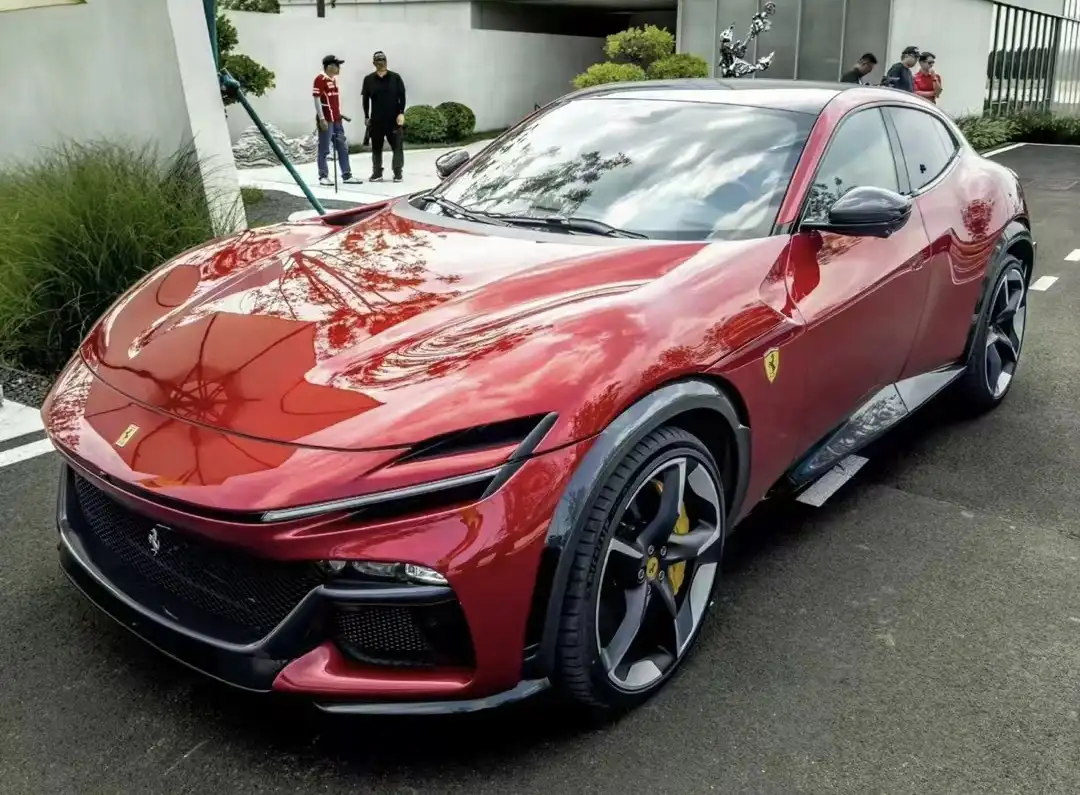
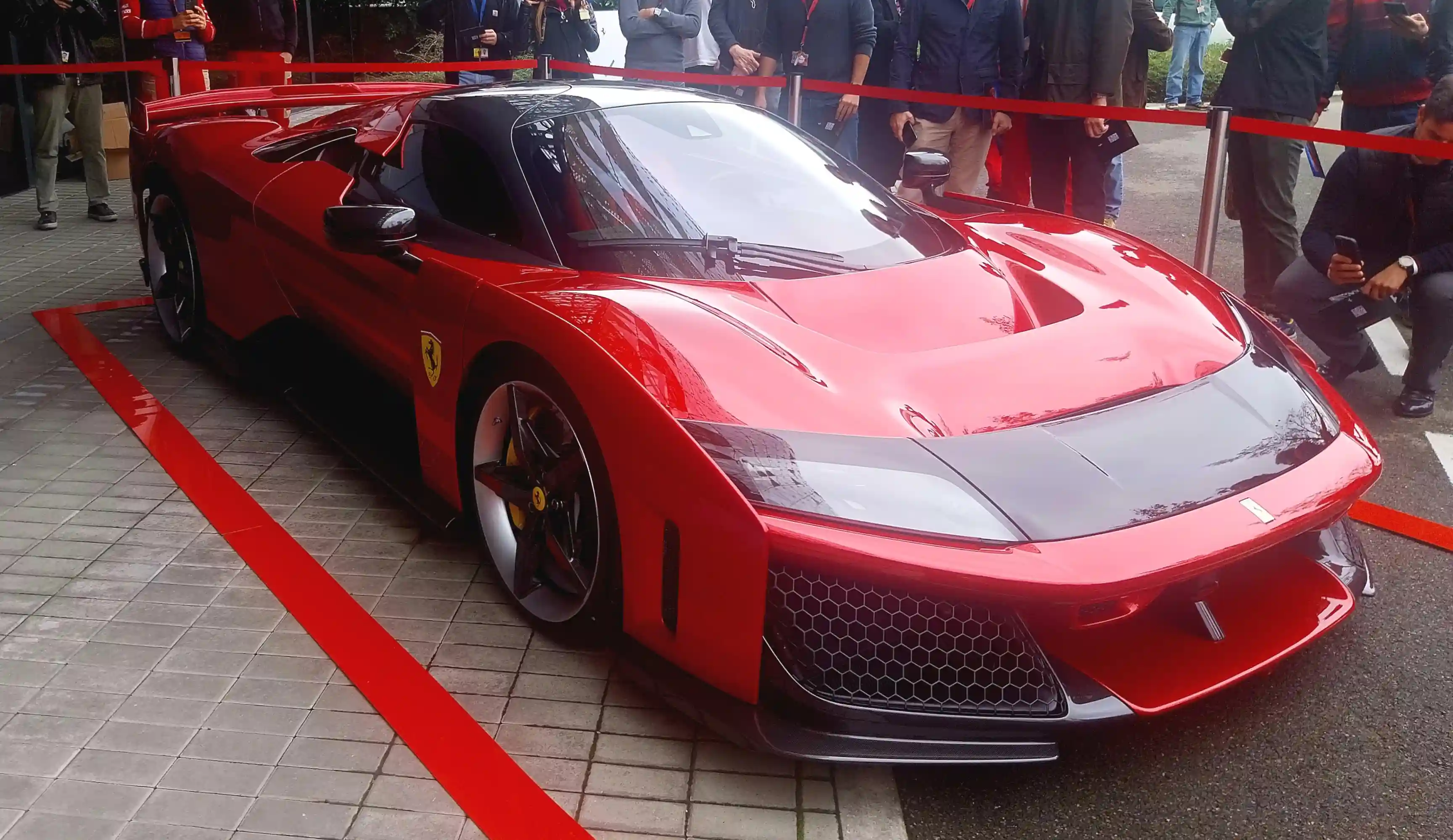
At the summit live the limited series — the Daytona SP3, the F80 flagship hypercar — offered not to whoever can pay but to clients whose purchase history has earned them the right. The mechanism creates something close to a switching cost: leave Ferrari and you abandon your place in a queue that took years and several cars to reach. Alongside the cars sits Ferrari Luce and a widening set of brand expressions; beneath them, the powertrain transition — the 2025 mix was already ~42% hybrid against ~58% pure combustion, with the fully-electric Elettrica arriving across 2025–2026. The Elettrica is the model to watch: it is the first test of whether scarcity economics transfer intact to a new technology.
.webp)
Racing as the Marketing Budget
Ferrari does not advertise. It races.
Scuderia Ferrari is Formula 1's oldest and most storied team — the only one to have been present since the championship's beginning — and it functions as a permanent, global marketing engine. Where a consumer brand buys attention with advertising, Ferrari earns it on race weekends in front of one of the largest recurring audiences in world sport, dozens of times a year, every year. The endurance programme compounds it: the 499P prototype returned Ferrari to the top class of Le Mans and won.
The economic point is subtle but important: racing lets Ferrari stay constantly, emotionally present in hundreds of millions of lives without ever cheapening itself with mass-market promotion. The brand is refreshed weekly; the exclusivity is never touched. It is the only advertising model in the world where the advertisement itself deepens the myth.
Small on Purpose: Distribution and Adjacencies
About 181 dealers on the entire planet — and a brand sold to millions who will never own the car.
Ferrari's distribution network is minute by design: roughly 181 dealers across about 195 points of sale in some 60 markets as of 2025. A mass brand operates thousands of outlets in single countries. The small network keeps the client experience controlled, keeps allocation decisions close to Maranello, and keeps the data on who buys, collects and flips flowing back to the company. Ferrari Financial Services sits alongside, financing purchases and deepening the client relationship.
Around the cars, Ferrari runs a licensing and lifestyle business — retail stores, restaurants, fashion collections, theme parks. The revenue is a modest slice, but the strategic role is outsized: it monetizes the brand's vast audience of admirers who will never receive an allocation, and it keeps Ferrari present in the lives of people who may one day become clients. The risk — brand dilution through overexposure — is real, and the company manages the portfolio with the same rationing instinct it applies to cars.
Where the Cars Go
Europe first, America second — and China deliberately small.
Ferrari discloses where its cars go in units, not revenue — so the picture below is a unit story, but a revealing one. Over 2020–2025 the Americas were the growth engine: deliveries rose 69%, from 2,325 to a 2024 peak of 4,003, with the United States alone taking 3,401 cars in 2025 — about a quarter of every Ferrari built. EMEA remained the steady, largest base, roughly 46% of volume and up 32% over the period. Rest of APAC — Japan, Australia, South Korea and others — grew a solid 59%. The exception, and the warning, is Greater China: it boomed to a 1,552-unit peak in 2022, then fell about 39% to just 941 by 2025 (Mainland China alone halved, 1,290 to 584). Ferrari's deliberate under-exposure to China — under 7% of volume — has turned from a curiosity into a shield as the market that whipsaws the rest of luxury contracts.
Americas climbed then eased in 2025; EMEA is the steady base; Greater China boomed to 2022 then fell ~39%; Rest of APAC grew steadily. Ferrari rations allocation by region, so no single market's downturn can dominate.
The contrast with the broader luxury sector is stark. The great European houses ride the Chinese consumer cycle up and down; Ferrari, by keeping its Greater China allocation small, has largely opted out of that volatility. Scarcity, it turns out, is also a hedging strategy: when every region gets fewer cars than it wants, weakness in one is absorbed by unmet demand in the others.
The Economics of Desire
Why demand for a Ferrari rises with its price — and what that does to a profit-and-loss account.
Veblen Goods: When the Demand Curve Bends Backwards
For most products, a higher price means fewer buyers. Ferrari is not most products.
Economics has a name for products people want more as they get more expensive: Veblen goods. For a Veblen good, price is not a barrier to the purchase — it is part of the product. The buyer is consuming exclusivity itself, and a high price is the certificate that the exclusivity is genuine. Cut the price of a Ferrari and you would not widen demand; you would damage the very thing being bought. A cheaper Ferrari is a worse Ferrari.
This is the deep logic beneath the most striking pattern in this report: average revenue per car up 42% in five years while the waiting list lengthened. In a normal market those two lines cannot move together. In a Veblen market, they reinforce each other — every price rise reaffirms the object's status, and the queue grows.
Scarcity as an Asset
Most companies fight their capacity constraints. Ferrari cultivates one.
A conventional manufacturer treats unmet demand as money left on the table and races to add capacity. Ferrari treats its production ceiling as an asset — invisible on the balance sheet but arguably the most valuable thing it owns. Rationed supply keeps residual values high: Ferraris hold their worth in the used market unusually well, and the rarest models appreciate outright, trading as collectible assets. The consequence loops back into demand — a buyer who believes the car will hold or gain value experiences a far lower true cost of ownership, making the purchase easier to justify at ever-higher prices.
Scarcity is the only asset that grows more valuable the more strictly you refuse to use it.
A Customer Base That Renews Itself
The world creates wealthy buyers faster than Maranello creates cars.
Ferrari sells to the ultra-high-net-worth population, and that population is not a fixed pool — global wealth creation replenishes and expands it continuously, in every region, through every cycle. As long as the world mints new fortunes faster than Ferrari raises output — and the gap is enormous — the structural excess of demand over supply widens by itself, year after year, without Ferrari lifting a finger.
The existing clientele compounds the effect. Ferrari ownership is habitual and cumulative: collectors hold multiple cars and buy repeatedly, because the product ladder makes today's purchase the qualification for tomorrow's allocation. Walking away from the brand means surrendering a queue position accumulated over years — a switching cost with no contract behind it, and all the more binding for that.
Identity, Not Transport
Nobody cross-shops a Ferrari against alternatives. That absence is the pricing power.
A rational car buyer compares specifications and prices across brands, and that comparison disciplines every manufacturer's pricing. A Ferrari buyer is not making that kind of decision. The purchase is emotional and identity-driven — membership of a story that has been accumulating since 1929, renewed every race weekend. There is no spreadsheet comparison because, in the buyer's mind, there is no substitute; and where there is no substitute, there is no competitive ceiling on price.
Pricing power is simply what brand equity looks like when it reaches the income statement. The margin ladder charted later in this report — operating margin climbing from 20.7% to 29.5% in six years — is not an operations story. It is ninety-six years of accumulated myth being monetized, a few percentage points at a time.
The Right Comparables — and the One Real Risk
Judge Ferrari against Hermès, not Volkswagen. Then guard the thing that makes it Hermès.
Everything above yields a practical instruction for the investor: choose the right comparison set. Ferrari's economic siblings are Hermès, LVMH and Richemont — houses that ration supply, cultivate waiting lists and sell identity — not Toyota, Volkswagen and Ford. The parallel with Hermès is almost mechanical: like the Birkin bag, a Ferrari is allocated rather than sold, waited for rather than bought, and resold at prices that vindicate the queue. The stock market has, in broad strokes, accepted the reframing — Ferrari trades at luxury-house multiples far above any mass automaker, and is worth more than Ford while selling a tiny fraction of the cars. How much premium, exactly, and whether it is earned, is what we quantify in the valuation section that follows.
The honest caveat is that luxury economics are a consequence, not a birthright. Every dynamic in this section — Veblen demand, hard residuals, the loyalty ladder — flows from exclusivity, and exclusivity is destructible: by volume creep, by a mishandled technology transition, by overextension of the brand. This is why the refusals catalogued earlier are existential rather than aesthetic, and why the allocation-capped Purosangue and the coming Elettrica matter more than their unit counts suggest. The moat is behavioural, and management must choose to maintain it every single year.
They have, so far, chosen well — and the proof is six years of audited numbers, to which we now turn.
The Numbers Behind the Badge
How Ferrari doubled its money without selling more cars. Ferrari N.V. (NYSE: RACE) · FY2020–FY2025 · every figure sourced to Ferrari Annual Reports & Form 20-F filings. Values in € millions unless noted.
Read Ferrari's accounts the way you'd read a luxury house's, not a carmaker's. Between 2020 and 2025 revenue grew from €3.46 billion to €7.15 billion — it more than doubled. Over the same six years the number of cars Ferrari shipped rose from 9,119 to just 13,640, and in 2025 it actually fell. Everything in this section lives in the gap between those two facts.
The Price of a Ferrari Keeps Rising
Each car sold for €440,000 in 2025 — up from €311,000 in 2020.
A traditional automaker grows by building and selling more units. Ferrari does the opposite: it deliberately caps output and lets rising mix, personalization and price do the work. In 2025 it shipped 112 fewer cars than in 2024 yet grew revenue 7%. That is a luxury house's playbook, not an automaker's.
Scarcity isn't a constraint on Ferrari's business. It is the business.
Income Statement: Top Line to Bottom Line
Revenue, operating profit and net profit — all compounding together.
Notice that the bottom line grew faster than the top line: revenue up 2.1×, net profit up 2.6×. That only happens when each new euro of revenue is more profitable than the last — which is exactly what pricing power delivers.
The Margin Ladder
Every step up in price falls straight to the bottom line.
Because the extra revenue comes from mix and personalization rather than more factory output, very little of it is eaten by added cost — so margins rise alongside price. This is the single most important reason the market values Ferrari the way it does, which we take apart in the valuation section that follows this one.
Cash Flow: Generation vs. Investment
Operating cash is pulling away from what the business needs to spend.
Each column is a year's operating cash flow: the blue base is what Ferrari had to reinvest (capex), the green top is free cash. Operating cash flow nearly tripled (€838M → €2,349M) while capex stayed near €1bn — so the free-cash slice balloons from €129M to €1.3bn.
Ferrari collects deposits from buyers years before their cars are built — the order book already stretches into late 2027 — so cash lands early and reliably. With investment needs largely flat, that turns into a rapidly widening stream of free cash, which funds both the balance-sheet strength (next) and shareholder returns (below).
Balance Sheet: Equity Up, Debt Flat
The company got structurally stronger while it grew.
A weaker company grows by borrowing. Ferrari grew by retaining earnings: shareholders' equity rose 2.2× while gross debt was essentially flat, and the cash pile held near €1.4–1.7bn throughout. Set against roughly €2.8bn of profit-generating capacity a year, this is a fortress balance sheet — which is what lets management keep returning cash rather than hoarding it.
Paying Shareholders to Wait
Dividends and buybacks, climbing every single year.
In October 2025, at its Capital Markets Day, Ferrari raised its dividend target from 35% to 40% of adjusted net profit and unveiled the largest buyback in its history. The message for an investor: scarcity economics don't just produce a premium share price — they produce a rising stream of cash handed back along the way.
The Full Picture, Sourced
Every figure in this section, traceable to a filing.
| Metric (€M unless noted) | 2020 | 2021 | 2022 | 2023 | 2024 | 2025 |
|---|---|---|---|---|---|---|
| Income statement | ||||||
| Net revenue | 3,460 | 4,271 | 5,095 | 5,970 | 6,677 | 7,146 |
| EBITDA, adj. | 1,143 | 1,531 | 1,773 | 2,279 | 2,555 | 2,772 |
| Operating profit (EBIT) | 716 | 1,075 | 1,227 | 1,617 | 1,888 | 2,110 |
| Net profit | 609 | 833 | 939 | 1,257 | 1,526 | 1,600 |
| EBIT margin | 20.7% | 25.2% | 24.1% | 27.1% | 28.3% | 29.5% |
| Diluted EPS (€) | 2.88* | 4.50 | 5.09 | 6.90 | 8.46 | 8.96 |
| Deliveries (units) | 9,119 | 11,155 | 13,221 | 13,663 | 13,752 | 13,640 |
| Revenue / car (€k)† | 311 | 320 | 328 | 375 | 417 | 440 |
| Cash flow | ||||||
| Operating cash flow | 838 | 1,283 | 1,403 | 1,717 | 1,927 | 2,349 |
| Capex (PP&E + intangibles) | 709 | 750 | 824 | 911 | 1,064 | 1,013 |
| Industrial free cash flow | 171 | 642 | 758 | 932 | 1,027 | 1,535 |
| Balance sheet (year-end) | ||||||
| Total assets | 6,262 | 6,864 | 7,766 | 8,051 | 9,497 | 9,628 |
| Total equity | 1,789 | 2,211 | 2,602 | 3,071 | 3,543 | 3,915 |
| Total debt | 2,725 | 2,630 | 2,812 | 2,477 | 3,352 | 2,884 |
| Cash & equivalents | 1,362 | 1,344 | 1,389 | 1,122 | 1,742 | 1,468 |
| Net industrial debt | 543 | 297 | 207 | 99 | 180 | ~0 |
| Returns & capital | ||||||
| Return on equity‡ | — | 41.6% | 39.0% | 44.3% | 46.1% | 42.9% |
| Dividends paid | 208 | 160 | 252 | 329 | 445 | 537 |
| Buybacks | 130 | 231 | 397 | 461 | 581 | 785 |
* 2020 diluted EPS on an adjusted basis (a one-off trademark step-up tax benefit lifted reported diluted EPS to €3.28); adjustments existed only in 2020, so the series is otherwise comparable.
† Revenue per car = "cars & spare parts" revenue ÷ deliveries — a consistent proxy for average selling price; it includes spare parts/personalization, so it modestly overstates the pure vehicle price.
‡ ROE is TIER's calculation (net profit ÷ average equity); Ferrari does not report it. 2020 omitted for lack of a 2019 equity base in-scope.
Why Ferrari Trades at a Luxury Multiple
The market has already made the reclassification this report argues for. Ferrari is priced next to Hermès, not Toyota — and the gap between the two worlds is enormous.
The previous sections argued that Ferrari should be understood as a luxury house. The stock market, it turns out, agrees — and has for some time. As of early July 2026 Ferrari traded at roughly €355 a share (about $385), for a market capitalization near €63 billion (~$69 billion). On that price it carries a trailing price-to-earnings multiple in the mid-30s and an enterprise-value-to-EBITDA multiple around 20×. Those are not automaker numbers. They are luxury-house numbers.
Put Ferrari beside the two comparison sets and the point becomes impossible to miss. Against the great luxury houses — Hermès in the high-30s to 40× earnings, LVMH in the low-20s, Richemont in the mid-20s — Ferrari sits comfortably mid-pack. Against mass automakers — BMW around 6×, Mercedes-Benz around 7×, Toyota around 9× — it trades at a four-to-six-fold premium. The market is not confused about which industry Ferrari belongs to.
Ferrari (highlighted) sits inside the luxury band and far above every mass automaker. Tesla, at a P/E near 360×, is a growth-and-technology story on a scale of its own and is excluded from the chart to keep it readable.
The full comparison table below adds EV/EBITDA and operating margin, and it explains why the multiples split the way they do. Ferrari's ~29.5% operating margin is closer to Hermès than to any carmaker; its return on equity of roughly 43% is elite in any industry. High multiples are what the market pays for scarce, durable, high-margin cash flows — and by every operating measure, Ferrari's cash flows look like a luxury house's.
| Company | Category | ~P/E | ~EV/EBITDA | ~Op. margin |
|---|---|---|---|---|
| Ferrari (RACE) | Luxury / auto | ~36× | ~20× | 29.5% |
| Luxury houses | ||||
| Hermès | Luxury | ~40× | ~33× | ~40% |
| Brunello Cucinelli | Luxury | ~38× | ~18× | ~16% |
| Richemont | Luxury | ~26× | ~16× | ~19% |
| LVMH | Luxury | ~24× | ~18× | ~24% |
| Moncler | Luxury | ~22× | ~11× | ~28% |
| Automakers | ||||
| Porsche AG | Auto (premium) | ~14× | ~7× | ~14% |
| Toyota | Auto (mass) | ~9× | — | ~10% |
| Mercedes-Benz | Auto (mass) | ~7× | — | ~8% |
| BMW | Auto (mass) | ~6× | ~6× | ~8% |
| Tesla | Auto / tech | ~360× | ~130× | ~6% |
Approximate figures as of early July 2026, compiled from public market data; automaker EV/EBITDA is distorted by captive-finance debt and is shown only where comparable. Ferrari's operating margin is from its filings (see the financials section); peer margins are latest-reported approximations. Figures move daily and are illustrative of the comparison, not precise inputs.
So the question this section poses is not "why is Ferrari more expensive than Ford?" — the preceding sections answered that. The sharper question is the one the next section takes up: now that the market has correctly reclassified Ferrari as luxury and priced it accordingly, how much future excellence is already baked into that price?
Valuation: What the Market Is Already Pricing In
A great company and a great investment are not the same thing. The first is about the business; the second is about the price. Here we separate them.
Consistent with an initiation of coverage, we do not issue a price target. What we do instead is more useful: we show what a buyer at today's price is actually underwriting. We approach it two ways — a forward discounted-cash-flow (DCF) model built from stated assumptions, and a reverse DCF that asks what growth the current price implies. Both are TIER's own illustrative work, and both are only as good as their assumptions, which we put on the table so you can disagree with them.
A DCF estimates what a company is worth today by projecting the cash it will generate in future and discounting it back to the present (because a euro in 2035 is worth less than a euro today). Feed in growth and a discount rate, and it returns a value per share.
A reverse DCF runs the machine backwards: it takes today's share price as given and solves for the growth rate the market must be assuming. It converts "is it expensive?" into the far more answerable "what would have to be true for today's price to make sense?"
What We Assume
Starting point: 2025's €1.5 billion of industrial free cash flow, a near-zero net-debt balance sheet, and about 178 million diluted shares.
Our base case starts from roughly €1.6 billion of free cash flow in 2026 (Ferrari's own guidance is for at least €1.5 billion). We then assume free cash flow compounds at about 12% a year through 2030 — broadly consistent with high-single-digit revenue growth plus continued margin expansion and the operating leverage that scarcity provides — fading to about 7% a year through 2035, and a 3% terminal growth rate thereafter. We discount at a weighted-average cost of capital (WACC) of 8%, reflecting Ferrari's low leverage and stable, high-visibility earnings. On those assumptions, the business is worth on the order of €280–290 a share.
That is below the ~€355 the market was paying in early July 2026. In other words, on a conventional set of assumptions Ferrari screens as fully valued to modestly expensive — which is exactly what you would expect of a widely admired franchise that the market has already reclassified as luxury. The interesting work is in the scenarios and in the reverse DCF.
The market price (blue) sits between our base and bull cases — the market is paying for an above-base outcome. There is quality here, but on these assumptions little margin of safety.
| Scenario | FCF growth '26–'30 | FCF growth '31–'35 | Terminal | WACC | ~Value / share |
|---|---|---|---|---|---|
| Bear | 8% | 5% | 2.5% | 8.5% | ~€235 |
| Base | 12% | 7% | 3.0% | 8.0% | ~€285 |
| Bull | 15% | 9% | 3.5% | 7.0% | ~€420 |
| Market price (early Jul 2026) | ~€355 |
What the Price Implies
Turn the model around, and the number to underwrite comes into focus.
Hold the 8% discount rate fixed and solve for the growth that justifies ~€355, and the answer is roughly 14–15% free-cash-flow growth every year for a decade, then 3% forever. That is the bargain on offer at today's price: you are paying not for what Ferrari has done, but for a further ten years of mid-teens compounding on top of it. The bull who accepts a lower, luxury-grade discount rate — 7% rather than 8%, on the view that Ferrari's cash flows are as safe as a great luxury house's — needs less growth to get there, which is precisely why patient luxury investors have been willing to pay up.
At today's price you are not buying Ferrari's past. You are buying a decade of its future, in advance, at close to full price.
Is mid-teens compounding for ten years plausible? The record is on the bull's side: free cash flow grew from €171 million in 2020 to €1,535 million in 2025. But the law of large numbers is on the bear's: the same percentage growth is far harder to sustain on a €1.5 billion base than it was on a €170 million one, and each price rise consumes a little of the pricing power that funds the next. Our own reading is that Ferrari is a rare, genuinely superior business trading at a price that already reflects that superiority — quality without a margin of safety. Whether that is a buy depends entirely on your holding period and your required return, which is a judgement we leave with you.
The Competitive Position: Alone in Its Category
Ferrari's rivals fall into two camps — performance brands owned by volume groups, and independent luxury houses that don't make cars. Ferrari is the only company that is fully both.
Ask who competes with Ferrari and the honest answer is: no one, exactly. Its would-be rivals each lack one half of what makes Ferrari what it is.
The Performance Brands
Great cars, but owned by volume groups — and priced accordingly.
Lamborghini and Bentley sit inside Volkswagen; Rolls-Royce inside BMW; AMG is a division of Mercedes. Each makes extraordinary machines, but none is an independent, listed pure-play, so none is valued as a luxury house — their economics are absorbed into a mass-market parent and priced at mass-market multiples. Porsche AG is the instructive case: genuinely premium and separately listed since 2022, yet it builds several hundred thousand cars a year, which is precisely why it trades in the low teens rather than the mid-30s. Porsche chose scale; Ferrari chose scarcity; the multiples record the difference.
The pure-play independents that remain are cautionary tales. Aston Martin has been publicly listed and chronically loss-making, repeatedly diluting shareholders — the clearest possible evidence that the badge alone does not confer Ferrari's economics. McLaren has lurched through financial distress. The lesson runs straight back through this report: it is not the cars or the heritage that produce Ferrari's returns, but the discipline — the refusal to chase volume that Aston and McLaren could never quite maintain.
The Luxury Houses
The right economic peers — who happen not to make cars.
Ferrari's true comparables, as the valuation section showed, are Hermès, LVMH and Richemont. The parallel with Hermès is the tightest: both ration supply, cultivate multi-year waiting lists, refuse to discount, and enjoy resale prices that exceed retail. The one structural difference cuts in Ferrari's favour on durability and against it on growth: a Birkin can be made in far greater numbers if Hermès ever chose to; a hand-built mid-engined car cannot, which makes Ferrari's scarcity even harder to fake — but also caps how fast it can ever grow.
That is the two-sentence competitive summary. Ferrari is the only company on earth that combines a top-tier performance-car brand with the economics of an independent luxury house. It has no true competitor because occupying that intersection requires refusing the growth that every rival, sooner or later, has reached for.
The Risks: What Would Break the Thesis
The bull case rests entirely on one thing: that exclusivity holds. Every serious risk is, at root, a threat to that.
An initiation that only made the bull case would not be worth reading. The dynamics that make Ferrari extraordinary are also the dynamics that could unwind, and the risks below are ordered roughly by how much they threaten the core.
The top three below are scored on two axes — how likely each is (probability) and how much damage it does if it happens (impact). The remaining four are real but lower down the ledger.
The Elettrica is the first true test of whether scarcity and desire survive the move away from the combustion engine — the sound and mechanical drama that are part of the myth. If electric Ferraris command the same devotion and pricing, the moat is proven portable; if they do not, the single most important assumption in this report weakens. This is the one risk that can invalidate the whole thesis rather than merely dent it.
The moat is behavioural, and management is the only party who can erode it: too many Purosangues, an over-extended lifestyle and licensing business, one volume-chasing decision too many. Exclusivity took ninety-six years to build and could be spent in a few model cycles. Probability is low because the ownership structure is built to prevent exactly this — but the damage, if it came, would be permanent.
A mid-30s P/E prices in sustained excellence, so it offers little protection if anything stumbles. A business priced for perfection falls hard on the first genuine disappointment, even a temporary one — the multiple is both the reward and the risk. Unlike Risks 1 and 2 this does not break the business, only the entry price — but at today's valuation it is the most probable source of a drawdown.
- Luxury cyclicality and a global downturn. The ultra-wealthy are more insulated than mass consumers, and the multi-year order book cushions any single soft patch — but Ferrari is not immune to a deep, prolonged hit to global wealth and confidence.
- China — already the soft spot, but a small one. Greater China fell ~39% from its 2022 peak. The genuine risk is a broader Asian luxury slowdown; the mitigant, unusually, is that Ferrari's deliberate under-exposure (under 7% of volume) means China can hurt sentiment far more than it hurts the numbers.
- Tariffs and currency. US import tariffs and a strengthening euro both pressure margins on cars built in Italy and sold worldwide. Ferrari's pricing power lets it pass much of this through — it has raised prices to offset tariffs — but that same lever, used too often, is a slow tax on the exclusivity it depends on.
- Key-person and succession. The doctrine has survived three regimes, which is reassuring, but strategy this dependent on judgement is always exposed to the quality of the people at the top and the continuity of the anchoring shareholders.
Notice the through-line: with the partial exception of valuation, every risk on the list is a variation of a single question — can Ferrari keep being scarce and desired? That is the one assumption the entire investment case rests on, and it is why the electric transition and the discipline around the brand matter far more than any quarter's delivery number.
The Investment Debate: Bull, Base, Bear, and What to Watch
The strongest version of each side, the probabilities we attach to each, and the concrete signals that will tell you which one is winning.
Everything in this report converges on a single, unusually clean debate. Almost no one disputes that Ferrari is a superb business; the entire argument is about price. Here is each side at its strongest.
Ferrari is a one-of-a-kind asset: a luxury house with a ninety-six-year moat, structural pricing power, a self-renewing ultra-wealthy clientele, and an order book that pre-sells years of production. It has doubled revenue on flat volume, eliminated its industrial debt, and is now returning cash at a rising rate under an ownership structure built to think in decades. Businesses this good, this durable and this rare almost never come cheap — and over a long enough horizon, paying a fair price for an exceptional compounder beats paying a cheap price for a mediocre one.
TIER DCF value: ~€420/share (7% WACC, 15% FCF growth) — ~18% above today.
The central path: high-single-digit revenue growth, continued but decelerating margin expansion, and the scarcity doctrine intact under Vigna. Free cash flow compounds around 12% through 2030 and fades toward 7%, exactly as the last six years suggest it should on a larger base. It confirms Ferrari as a superb, durable compounder — but at a value modestly below today's price, meaning the market is already paying for an above-base outcome.
TIER DCF value: ~€285/share (8% WACC, 12%→7% FCF growth) — ~20% below today.
The price already reflects all of it. At a mid-30s earnings multiple, a buyer is underwriting roughly a decade of mid-teens cash-flow growth with no margin of safety, on a base large enough that the law of large numbers is now working against it. The electric transition threatens the very mystique the valuation depends on, and a stock priced for perfection punishes the smallest disappointment. A wonderful company, on this view, is simply not on offer at a wonderful price.
TIER DCF value: ~€235/share (8.5% WACC, 8% FCF growth) — ~34% below today.
Both cases are strong because both are largely true: the disagreement is not about the facts but about how much of the future a buyer should pay for today. That is a judgement about temperament and time horizon, not a fact we can settle for you. What we can do is tell you what to watch — the handful of indicators that will reveal, in real time, which case is prevailing.
- The order book. The single best real-time gauge of scarcity. As long as it stretches years out, demand exceeds supply and the model is intact; the first sign of it shortening would be the most important warning of all.
- The Elettrica's reception. Does the first fully-electric Ferrari command Ferrari pricing, personalization and waiting lists? This is the make-or-break test for the moat's portability into the next era.
- Operating margin. Continued expansion means pricing power is intact; a plateau or slip at this valuation would be an early crack in the thesis.
- Personalization intensity. Holding near ~20% of car revenue signals that clients are still spending without constraint — a direct read on the health of the pricing power.
- Discipline on volume and brand. Watch for any drift toward chasing units — a ballooning Purosangue allocation, an over-stretched lifestyle business. The refusals are the asset; watch that management keeps refusing.
The Catalyst Calendar
The dated events over the next year that will tell you which case is winning. Timing is approximate and based on Ferrari's usual reporting cadence.
The Verdict
Ferrari has spent nearly a century making the same choice — scarcity over scale — and has been rewarded for it with economics almost no company on earth can match. Our reading is unambiguous on the business and deliberately open on the price: this is a rare, genuinely superior franchise trading at a level that already reflects that superiority — quality without a margin of safety. The only question this report cannot answer for you is whether that price leaves enough on the table for the next investor. Judge it on the machine we have laid out, not on the badge.
Frequently Asked Questions
Is Ferrari (RACE) stock a good investment in 2026?
Ferrari is one of the highest-quality businesses in public markets — a ~29.5% operating margin, roughly 43% return on equity, and a moat almost no company can match. But at ~€355 a share it trades near a mid-30s P/E that already prices in roughly a decade of mid-teens growth. Whether it is a good investment depends on your holding period: as a long-term compounder the quality is real; as a value entry, there is little margin of safety today.
Why does Ferrari trade at a luxury multiple instead of a car-maker multiple?
Because it behaves like a luxury house, not an automaker. Ferrari deliberately builds fewer cars than customers demand, never discounts, and grows through price, mix and personalization rather than volume — revenue rose from €3.5bn to €7.1bn between 2020 and 2025 while deliveries barely moved. Those economics belong next to Hermès (~40× earnings), not Toyota (~9×).
What is Ferrari stock worth — does TIER have a price target?
This initiation does not issue a price target. Our illustrative DCF spans a bear case near €235, a base case near €285 and a bull case near €420, against a ~€355 market price. Read the other way, today's price implies about 14–15% free-cash-flow growth every year for a decade — a demanding bar for a business this size.
What are the biggest risks for Ferrari investors?
Three stand out. The electric transition (can the Elettrica command Ferrari-grade demand and pricing?) and self-inflicted brand dilution are both potentially thesis-breaking; valuation risk — a stock priced for perfection — is the most probable source of a near-term drawdown. Each traces back to one question: can Ferrari stay scarce and desired?
How does Ferrari compare to Hermès and Porsche?
Hermès is Ferrari's closest economic peer — both ration supply, cultivate multi-year waiting lists, and enjoy resale prices above retail. Porsche is the counter-example: genuinely premium but building several hundred thousand cars a year, which is why it trades in the low teens rather than the mid-30s. Ferrari chose scarcity; Porsche chose scale; the multiples record the difference.
This article is for educational and informational purposes only and is not investment advice; do your own due diligence and consult a qualified financial advisor before making any investment decision.