NVIDIA Q1 FY2027 Earnings: Revenue Hits $81.6 Billion as Jensen Huang Declares "Agentic AI has arrived"
By The Intelligence Edge Research Team · June 18, 2026 · 26 min read

NVIDIA Q1 FY2027: $81.6B Revenue, $75B Data center, $91B Q2 outlook. Jensen Huang: "Agentic AI has arrived." Full investor concall analysis
NVIDIA opened fiscal 2027 with $81.6 billion in revenue, 92% Data Center growth, and a $91 billion Q2 guidance that suggests the AI infrastructure cycle is not slowing — it is going parabolic. Here is what the numbers mean, what Jensen Huang’s language signals, and what investors must watch next.
- “Demand has gone parabolic.” Those were Jensen Huang’s opening words on May 20, 2026. Q1 FY2027 revenue of $81.6 billion (+85% YoY) beat the prior quarter by $13.5 billion — NVIDIA’s largest ever sequential dollar increase. This was the 3rd consecutive quarter of year-over-year revenue acceleration and the 14th straight quarter of sequential growth.
- Data Center hit $75.2 billion. Up 92% year-over-year and 21% sequentially, driven by GB300 NVL72 demand from every major hyperscaler and frontier model builder. Networking was the breakout sub-story: Spectrum-X is now larger than all Ethernet network peers combined; InfiniBand grew more than 4x year-over-year.
- Agentic AI is the new narrative anchor. Huang declared “Agentic AI has arrived. AI can now do productive and valuable work. Tokens are now profitable.” This is a direct escalation from “generative AI” as the demand driver and has major implications for the volume and cost-per-token economics that underpin hyperscaler CapEx decisions.
- Vera Rubin volume production confirmed for Q3 FY2027. Rubin is on track to begin volume production shipments in Q3 (August–October 2026) and will deliver 35x higher inference throughput and 10x more AI factory revenue than Blackwell. Huang stated that every single frontier model company will adopt Rubin “from the get go.”
- Record $20 billion returned to shareholders. NVIDIA announced an $80 billion new buyback authorization, a 25x quarterly dividend increase (from $0.01 to $0.25 per share), and a commitment to return approximately 50% of free cash flow to shareholders in FY2027.
Earnings Snapshot: Q1 FY2027 vs. Prior Quarter
NVIDIA reported on May 20, 2026, opening fiscal year 2027. Every headline metric set a company record for a single quarter.
| Metric | Q1 FY2027 (Reported) | Q4 FY2026 | Q1 FY2026 | YoY Change |
|---|---|---|---|---|
| Total Revenue | $81.6B | $68.1B | $44.1B | +85% |
| Data Center Revenue | $75.2B | $62.3B | $39.1B | +92% |
| → Hyperscale | $37.9B | $33.8B | $17.6B | +115% |
| → AI Clouds, Industrial & Enterprise | $37.4B | $28.5B | $21.5B | +74% |
| Edge Computing (new segment) | $6.4B | $5.8B | $5.0B | +29% |
| GAAP Gross Margin | 74.9% | 75.0% | 60.5% | +14.4 pts |
| Non-GAAP Gross Margin | 75.0% | 75.2% | 60.8% | +14.2 pts |
| GAAP Net Income | $58.3B | — | $18.8B | +211% |
| GAAP Diluted EPS | $2.39 | — | $0.76 | +214% |
| Non-GAAP Diluted EPS | $1.87 | — | $0.78 | +140% |
| Free Cash Flow | $48.6B | — | $26.1B | +86% |
| Q2 FY2027 Revenue Guidance | $91.0B ±2% — no China Data Center compute assumed | — | ||
| Q2 FY2027 Gross Margin Guidance | 74.9% GAAP / 75.0% Non-GAAP ±50 bps | — | ||
Three Numbers That Matter
New Reporting Framework: Data Center + Edge Computing
Starting Q1 FY2027, NVIDIA transitioned to a new two-platform reporting structure that better reflects how the company is managed and how revenue is generated. The prior breakdown (Data Center, Gaming, Professional Visualization, Automotive, OEM) has been replaced.
Data Center now reports two sub-markets. Hyperscale ($37.9B in Q1 FY2027) covers the major public clouds and large consumer internet companies. ACIE — AI Clouds, Industrial & Enterprise ($37.4B) covers AI-native clouds, sovereign AI deployments, enterprise on-premises, and industrial AI. The near-equal split between Hyperscale and ACIE is the most important structural signal in Q1: NVIDIA’s revenue is no longer concentrated in a handful of hyperscalers. The second, more diverse category is now almost as large.
Edge Computing ($6.4B, +29% YoY) consolidates Gaming, Professional Visualization, Automotive, AI-RAN base stations, robotics, and autonomous devices. The new label is deliberate: it positions what was previously “consumer” or “gaming” revenue as part of the physical AI and agentic AI wave. Jensen Huang described the edge as “the next wave” and CUDA as the platform that extends all the way from the data center to embedded medical instruments.
Blackwell: Deployed by Every Major Hyperscaler, Every Cloud, Every Model Builder
The GB300 NVL72 — NVIDIA’s flagship Blackwell Ultra system — saw particularly strong demand from frontier model builders in Q1 FY2027. Each major hyperscaler has now cumulatively deployed hundreds of thousands of Blackwell GPUs, marking what NVIDIA calls the fastest product ramp in company history. Key deployment milestones from the earnings call:
| Customer | Blackwell Deployment Milestone (Q1 FY2027) |
|---|---|
| Microsoft | Fairwater facility — the world’s most powerful AI data center — went live ahead of schedule, powered by hundreds of thousands of Blackwell GPUs |
| OpenAI | GPT-5.5 was co-designed for, trained with, and is currently served on the Blackwell architecture; top of Artificial Analysis leaderboards |
| AWS | Adding more than 1 million Blackwell and Rubin GPUs to its infrastructure |
| Offering Blackwell to cloud customers with confidential computing capabilities; A5X bare-metal instances can support up to 960,000 Rubin GPUs across multiple sites | |
| Anthropic | NVIDIA coverage of Anthropic “largely zero until just recently” — now gaining inference share rapidly across Azure, AWS, and CoreWeave capacity |
| Supply Commitment | NVIDIA increased total supply (inventory + purchase commitments + prepaids) to $145 billion to remain front-footed on demand |
| $1T Order Visibility | Management confirmed “full confidence in $1 trillion in Blackwell and Rubin revenue from 2025 through calendar 2027” |
Jensen Huang’s Worldview: “Agentic AI Has Arrived”
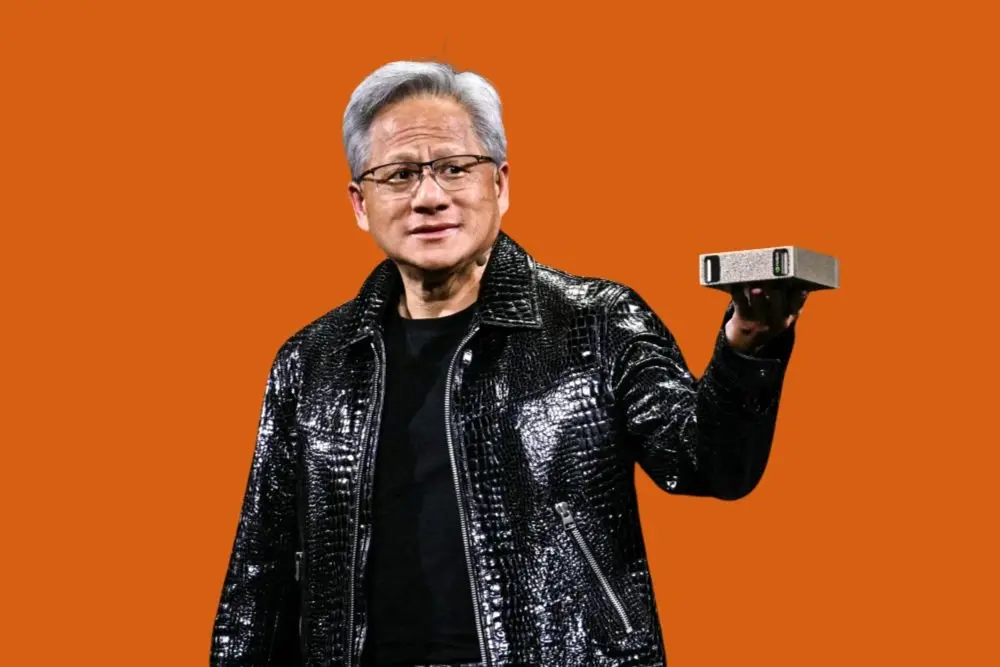
Jensen Huang opened his Q1 FY2027 remarks with a phrase designed to shift investor perception from “AI is promising” to “AI is productive.” “Agentic AI has arrived. AI can now do productive and valuable work. Tokens are now profitable.” This is not a vague bullish statement — it is a specific claim about unit economics. When tokens become profitable for the entities producing them (OpenAI, Anthropic, xAI, and hundreds of enterprise AI deployments), the rational response is to produce more tokens — and producing more tokens means buying more GPUs.
Huang also made a subtle but important refinement to his “compute equals revenue” thesis. The Q1 FY2027 version was sharper: “It is very clear compute is revenues, compute is profit.” Adding “profit” is significant. A pure revenue argument can be deflected with a margin question. A profit argument — backed by OpenAI and Anthropic reporting that they now grow revenue within a month what SaaS companies took a decade to build — makes the CapEx case structurally much harder to argue against.
The most forward-looking insight from Q1 FY2027 was Huang’s framing of the two-category demand structure. Category one is the hyperscalers, whose aggregate CapEx he called “$1 trillion this year, and I have every expectation it’s going to grow from there.” Category two is everything else: AI-native clouds, sovereign AI governments, and 250,000 enterprise companies globally that will need to build or operate their own AI factories. Category two is now roughly equal in size to category one. This is the figure the market has consistently underpriced. The hyperscaler story is well-covered. The sovereign-plus-enterprise story is not.
On economics: “The economics of the past was dollars per core. The economics of AI of the future is tokens per dollar or dollars per token.” This framing has a direct implication for the Vera CPU: agents, unlike traditional cloud tenants, do not rent cores. They just want work done fast. NVIDIA’s Vera CPU was purpose-built for this model.
Vera Rubin: Volume Production Confirmed for Q3 FY2027
Vera Rubin is no longer a roadmap item — it is a shipping product. NVIDIA confirmed volume production shipments beginning in Q3 FY2027 (August–October 2026), with first samples already in customer hands since Q4 FY2026. The platform comprises seven purpose-built chips across five accelerated racks.
Vera Rubin delivers up to 35x higher inference throughput and up to 10x greater AI factory revenue compared with Blackwell. Its modular, cable-free tray design also improves resiliency and serviceability relative to Blackwell’s liquid-cooled rack architecture. Jensen Huang stated directly: “Vera Rubin is going to be even more successful than Grace Blackwell at this point. Every single frontier model company will jump on Vera Rubin from the get go — and that wasn’t true before on Blackwell.” Google has already prepared A5X bare-metal instances supporting up to 960,000 Rubin GPUs across multiple sites as an early adopter. Separately, the Vera standalone CPU — purpose-built as an agentic processor — is now a fourth product line alongside Vera Rubin, Vera–CX9 storage, and Vera standalone.
Five Things Investors Learned From NVIDIA’s Q1 FY2027 Earnings Call
- The revenue acceleration is not plateauing — it is steepening. Q1 FY2027 was NVIDIA’s third consecutive quarter of year-over-year revenue acceleration (69% → 85%) and its 14th straight sequential growth quarter. The $13.5 billion sequential increase was the largest in company history. Most models anticipated deceleration as the base grew larger. The opposite happened.
- Category Two — enterprises, AI-native clouds, and sovereigns — is now nearly the size of hyperscalers. ACIE revenue ($37.4B) is almost equal to Hyperscale ($37.9B) in Q1 FY2027. For the past two years the NVIDIA bull thesis rested on five or six hyperscalers. That thesis is correct but incomplete: there are now hundreds of AI-native clouds and thousands of enterprise and sovereign deployments generating equivalent revenue. This second category is structurally harder to displace with custom ASICs and grows faster as the base is less consolidated.
- Networking is the hidden growth engine within Data Center. Data Center networking revenue reached $15 billion in Q1, nearly tripling year-over-year. Spectrum-X — NVIDIA’s Ethernet platform for AI — is now larger than all other Ethernet network providers combined. InfiniBand grew more than 4x year-over-year. This is not commoditised infrastructure revenue. It is high-margin, differentiated networking tied directly to GPU cluster scale — and it has no obvious near-term challenger.
- The dividend increase is a confidence signal, not just a capital allocation event. Raising the quarterly dividend from $0.01 to $0.25 per share — a 25x increase — while simultaneously announcing an $80 billion buyback authorisation and committing to return 50% of free cash flow requires genuine confidence in sustained free cash flow generation. At $48.6 billion in free cash flow for a single quarter, NVIDIA has more than enough capacity — but management has now made the commitment public and reviewable. This is a high-conviction signal about the durability of the earnings trajectory.
- Rubin changes the competitive dynamics for custom silicon more than Blackwell did. Huang’s argument is that NVIDIA supports the entire AI lifecycle (data processing, pre-training, post-training, RLHF, inference) simultaneously — something no custom ASIC can claim. Rubin adds 35x inference throughput on top of that full-stack advantage. If Rubin achieves the adoption Huang projects — every frontier model company, from day one — the window for ASICs to take share in inference (the segment where they are most competitive) narrows considerably.
Capital Returns: The 25x Dividend and $80 Billion Buyback
NVIDIA’s capital return programme scaled materially in Q1 FY2027, reflecting management’s confidence in the durability of free cash flow generation.
| Capital Return Item | Detail |
|---|---|
| Record Quarterly Capital Return | ~$20 billion returned to shareholders in Q1 FY2027 alone |
| New Share Repurchase Authorization | $80 billion new buyback — on top of ~$39 billion remaining on the existing plan (~$119B total available) |
| Quarterly Dividend Increase | $0.01 → $0.25 per share — a 25× increase, effective Q1 FY2027 |
| Free Cash Flow Target | Management targeting ~50% of free cash flow returned to shareholders throughout FY2027 |
| Q1 FY2027 Free Cash Flow | $48.6 billion (+86% YoY from $26.1B in Q1 FY2026) |
| Supply Commitment | $145 billion total supply (inventory + purchase commitments + prepaids) to support demand ahead |
Risks and Headwinds
- China: effectively foreclosed, tariff risk compounding. NVIDIA’s 10-K states it is “effectively foreclosed from competing in China’s data center computing market.” The February 2026 H200 licence requires US inspection before export, triggering a 25% tariff that NVIDIA may not be able to pass to customers. No H200 revenue has been generated under the licence. Q2 FY2027 guidance excludes all China Data Center compute. The structural consequence: Chinese competitors are using NVIDIA’s absence to build developer and customer ecosystems that could challenge NVIDIA globally over a multi-year horizon.
- Supply constraints on $145 billion of commitments. NVIDIA has committed $145 billion in supply to support customer demand. While management expressed confidence, the company explicitly acknowledged it is “not immune to supply challenges.” TSMC capacity, HBM memory supply, OSAT packaging, and CoWoS interposer availability remain the key variables. Any disruption at TSMC in Taiwan — for geopolitical or operational reasons — would propagate immediately to NVIDIA’s ability to fulfil those commitments.
- Gross margin pressure during the Rubin ramp. GAAP gross margin was 74.9% in Q1 FY2027 vs 75.0% in Q4 FY2026 — essentially flat but marginally lower. Full-year FY2027 guidance is mid-70s, implying the Rubin transition in H2 FY2027 may introduce temporary compression as seven-chip system complexity and early yields are absorbed. Investors should monitor whether the Rubin ramp looks more like Blackwell’s smooth margin trajectory or whether it introduces a step-down.
- Custom ASIC competition intensifying at the edge of the TAM. Google (TPU), Amazon (Trainium), Meta (MTIA), and Microsoft (Maia) are all investing in bespoke inference accelerators. Huang’s competitive argument is structural: ASICs optimise for one workload; NVIDIA runs all workloads on one platform. But as inference becomes the dominant workload and the economics of narrow, repetitive token generation improve, ASIC economics in high-volume inference — not training — may erode a portion of NVIDIA’s share even if the overall market is growing.
AI Industry Context
| Company | Role in AI Infrastructure | Competitive Position vs NVIDIA (Q1 FY2027) |
|---|---|---|
| AMD (CDNA 4) | GPU competitor; MI300X/MI400 targets training | Growing share in select enterprise workloads; CUDA ecosystem depth and Rubin’s 35x inference advantage widen the gap |
| Broadcom | Custom ASIC for Google TPU, Meta MTIA; Ethernet networking | Strongest ASIC competitor; Spectrum-X now larger than all Ethernet peers combined suggests NVIDIA is winning the networking layer |
| TSMC | Sole foundry for all Blackwell and Rubin chips | Critical dependency; TSMC’s capacity constraints are simultaneously NVIDIA’s bottleneck and a barrier to new entrants |
| Anthropic / OpenAI / xAI | Frontier model builders and largest inference operators | Confirm Blackwell as the production platform; Rubin adoption expected “from the get go” by all frontier model companies |
| Huawei (Ascend) | Chinese domestic GPU alternative to fill void left by H20/H200 ban | Benefiting from NVIDIA’s China absence; developer ecosystem growing; not yet competitive at frontier model scale globally |
Analyst Q&A: The Questions That Matter
On the sustainability of hyperscaler CapEx at $1 trillion: Huang’s answer was direct and economic rather than aspirational: “If they don’t have the compute, they won’t have the revenues. It is very clear compute is revenues, compute is profit.” He cited both the token economics of frontier models and the physical world dependency of industrial AI (noting that a chip fab cannot run its AI control systems from a cloud service provider) as structural arguments for why compute spend is not discretionary.
On ASIC competition and inference share: Huang acknowledged that SRAM-based, decode-focused inference accelerators (referencing Groq’s LPX) could be “a niche product for some time” in high-token-rate, narrow inference use cases. His counter-thesis: NVIDIA’s Grace Blackwell supports the “entire life cycle of AI from data processing, pre-training, post-training, RLHF, all the way to inference” — something no ASIC can do. Where the customer needs all phases simultaneously (the majority of enterprise and hyperscaler workloads), NVIDIA remains the only viable platform.
On the Vera CPU and the economics of agentic AI: Huang argued that agents represent a fundamentally different compute model than cloud tenants: “Agents don’t rent cores. They just want the work to be done fast.” Vera was built for this: maximum throughput per dollar rather than maximising rentable cores. The Vera standalone CPU — in addition to its role paired with Rubin GPUs — is now a distinct revenue line targeting agentic workloads and storage infrastructure.
Stock Reaction and Live Chart
NVIDIA’s Q1 FY2027 print — $81.6 billion in revenue vs a guidance midpoint of $78 billion, plus a $91 billion Q2 guide and a 25x dividend increase — represented a decisive beat-and-raise that exceeded both the revenue and capital return expectations the market had built in heading into the call. The gross margin stability at 75% and the confirmation of Rubin’s Q3 production schedule removed the two most commonly cited near-term risk scenarios.
What Investors Should Watch Next Quarter
- Vera Rubin first commercial revenue in Q3 FY2027. Volume production shipments beginning Q3 (August–October 2026) means the first Rubin revenue should flow into Q3 financials. Watch for any supply or yield commentary on the seven-chip platform — this is the most complex system NVIDIA has built. A clean ramp supports the 35x throughput claim and the “10x AI factory revenue” projection. A stumble would be the most consequential negative event of the fiscal year.
- Whether ACIE exceeds Hyperscale revenue in Q2. In Q1, ACIE ($37.4B) was almost equal to Hyperscale ($37.9B). If ACIE crosses above Hyperscale in Q2 FY2027, it confirms that the second demand category — enterprise, AI-native clouds, sovereign AI — has become NVIDIA’s primary growth engine. This would be a structural re-rating catalyst for investors still pricing the company primarily as a hyperscaler supplier.
- China: H200 licence revenue or regulatory escalation. The H200 licence exists but has generated zero revenue. Two scenarios diverge from here: (a) imports are permitted into China, generating a material revenue line currently excluded from guidance; or (b) the antitrust or tariff situation escalates further. Either scenario is material. The 25% tariff on H200 imports makes the economics of any China re-entry complex even if regulatory clearance is granted.
- Free cash flow and the 50% return commitment. NVIDIA committed to returning approximately 50% of free cash flow to shareholders in FY2027. At Q1’s $48.6 billion FCF run rate, that implies roughly $24 billion per quarter in buybacks and dividends. Watch whether actual capital returns track the commitment as Rubin ramp capex and supply commitments increase in H2 FY2027.
Key Terminology
- CUDA
- NVIDIA’s parallel computing platform, launched in 2006. Twenty years of CUDA libraries, frameworks, and developer tooling is NVIDIA’s deepest competitive moat: it is the software layer that makes NVIDIA GPUs the default choice for every major AI framework (PyTorch, TensorFlow, JAX) and the reason switching to a competitor requires rewriting software, retraining teams, and forgoing performance-optimised libraries.
- GB300 NVL72
- NVIDIA’s current flagship Blackwell Ultra system. A single rack connects 36 Grace CPUs and 72 Blackwell GPUs in a liquid-cooled chassis, functioning as one unified computer. Delivers 50x more performance per watt vs the prior Hopper generation. Demand for GB300 NVL72 was described as “particularly strong” in Q1 FY2027, with every major hyperscaler and frontier model builder deployed.
- Vera Rubin
- NVIDIA’s next-generation AI platform, entering volume production Q3 FY2027. Comprises seven purpose-built chips across five accelerated racks; delivers 35x higher inference throughput and 10x more AI factory revenue vs Blackwell. The Vera CPU component is also sold standalone as an agentic processor — purpose-built for workloads where agents need fast throughput rather than rentable cores.
- Agentic AI
- Jensen Huang’s term for the current phase of AI deployment, where AI systems act autonomously to complete multi-step tasks rather than responding to single prompts. Agentic AI generates far more tokens per user interaction than generative AI, increasing compute demand per workload and making token unit economics the central business metric for all AI infrastructure operators.
- AI Factory
- Jensen Huang’s reframing of the modern data center as a productive asset — analogous to a power plant or manufacturing facility — that converts electricity into tokens (digital intelligence). Under this model, AI factory revenue equals the value of tokens produced, which is why “compute equals revenue and profits” is not a metaphor but a provable financial relationship.
- Spectrum-X
- NVIDIA’s end-to-end Ethernet networking platform, purpose-built for AI data centers. As of Q1 FY2027, Spectrum-X is larger than all other Ethernet network providers combined. Together with InfiniBand (which grew 4x+ YoY in Q1), it represents approximately $15 billion in quarterly networking revenue — a business that barely existed three years ago.
Frequently Asked Questions
What were NVIDIA’s Q1 FY2027 earnings results?
NVIDIA reported Q1 FY2027 revenue of $81.6 billion (+85% year-over-year, +20% sequentially) — the largest sequential dollar increase in company history at $13.5 billion. Data Center revenue was $75.2 billion (+92% YoY). GAAP gross margin was 74.9%. GAAP net income was $58.3 billion (+211% YoY) with diluted EPS of $2.39 (+214% YoY). Free cash flow was $48.6 billion. Results were reported on May 20, 2026.
What is NVIDIA’s Q2 FY2027 guidance?
NVIDIA guided Q2 FY2027 revenue of $91.0 billion, plus or minus 2%. GAAP gross margin is expected at 74.9% and non-GAAP gross margin at 75.0%, both ±50 basis points. Non-GAAP operating expenses are expected to be approximately $8.3 billion. The guidance explicitly excludes all Data Center compute revenue from China. Full-year FY2027 non-GAAP gross margins are guided to the mid-70s.
What is the new NVIDIA reporting framework?
Starting Q1 FY2027, NVIDIA replaced its prior segment breakdown with two market platforms: Data Center (with sub-markets Hyperscale and ACIE) and Edge Computing. Edge Computing consolidates what was previously reported as Gaming, Professional Visualization, Automotive, and OEM into a single platform reflecting NVIDIA’s positioning around physical AI, robotics, AI-RAN, and agentic devices. Historical nine-quarter data under the new framework has been published on NVIDIA’s investor relations website.
When will Vera Rubin ship?
Vera Rubin volume production shipments are confirmed to begin in Q3 FY2027 (August–October 2026). First samples were shipped to customers in Q4 FY2026 (February 2026). Google is the most prominent announced early adopter, with A5X bare-metal infrastructure supporting up to 960,000 Rubin GPUs across multiple sites. Jensen Huang stated that every single frontier model company is expected to adopt Rubin from launch.
How does NVIDIA’s China situation stand in Q1 FY2027?
NVIDIA has generated no revenue under the H200 export licence granted by the US government in February 2026. Any H200 exported to China under the licence must first undergo a US inspection process and is then subject to a 25% tariff upon importation into the US. NVIDIA’s own 10-K states the company is “effectively foreclosed from competing in China’s data center computing market.” Q2 FY2027 guidance assumes zero China Data Center compute revenue. The company has warned that its absence is allowing domestic Chinese competitors to build ecosystems that could challenge NVIDIA globally.
Is NVIDIA stock a buy after Q1 FY2027 earnings?
This article does not provide investment advice. The Q1 FY2027 results confirm: demand acceleration (not deceleration) despite a massive revenue base; a second demand category (ACIE) nearly matching hyperscalers in size; Rubin on track; gross margins stable at 75%; and a dramatically enhanced capital return programme. The key risks remain China regulatory uncertainty, Rubin ramp execution, and ASIC competition at the margin. Investors should assess these against their own risk tolerance and time horizon, and consult a qualified financial adviser before making investment decisions.
Sources & Disclosures
- NVIDIA Q1 FY2027 Earnings Call Transcript (Corrected) — May 20, 2026
- NVIDIA Q1 FY2027 CFO Commentary & Financial Presentation — May 20, 2026
- NVIDIA Q1 FY2027 Press Release & Earnings Supplement
- NVIDIA FY2026 Annual Report (Form 10-K) — Year ended January 25, 2026 (risk factor disclosures)
- NVIDIA Q4 FY2026 Earnings Call Transcript — February 25, 2026
- Nine-quarter revenue by market platform via NVIDIA Investor Relations (new reporting framework)
- Live price data via TradingView (NASDAQ: NVDA)
This article is for educational and informational purposes only and is not investment advice; do your own due diligence and consult a qualified financial adviser before making any investment decision.