SpaceX IPO (SPCX): The largest in History: Key Numbers, Market Reaction, and What Investors Should Watch
By The Intelligence Edge Research Team · June 18, 2026 · 18 min read
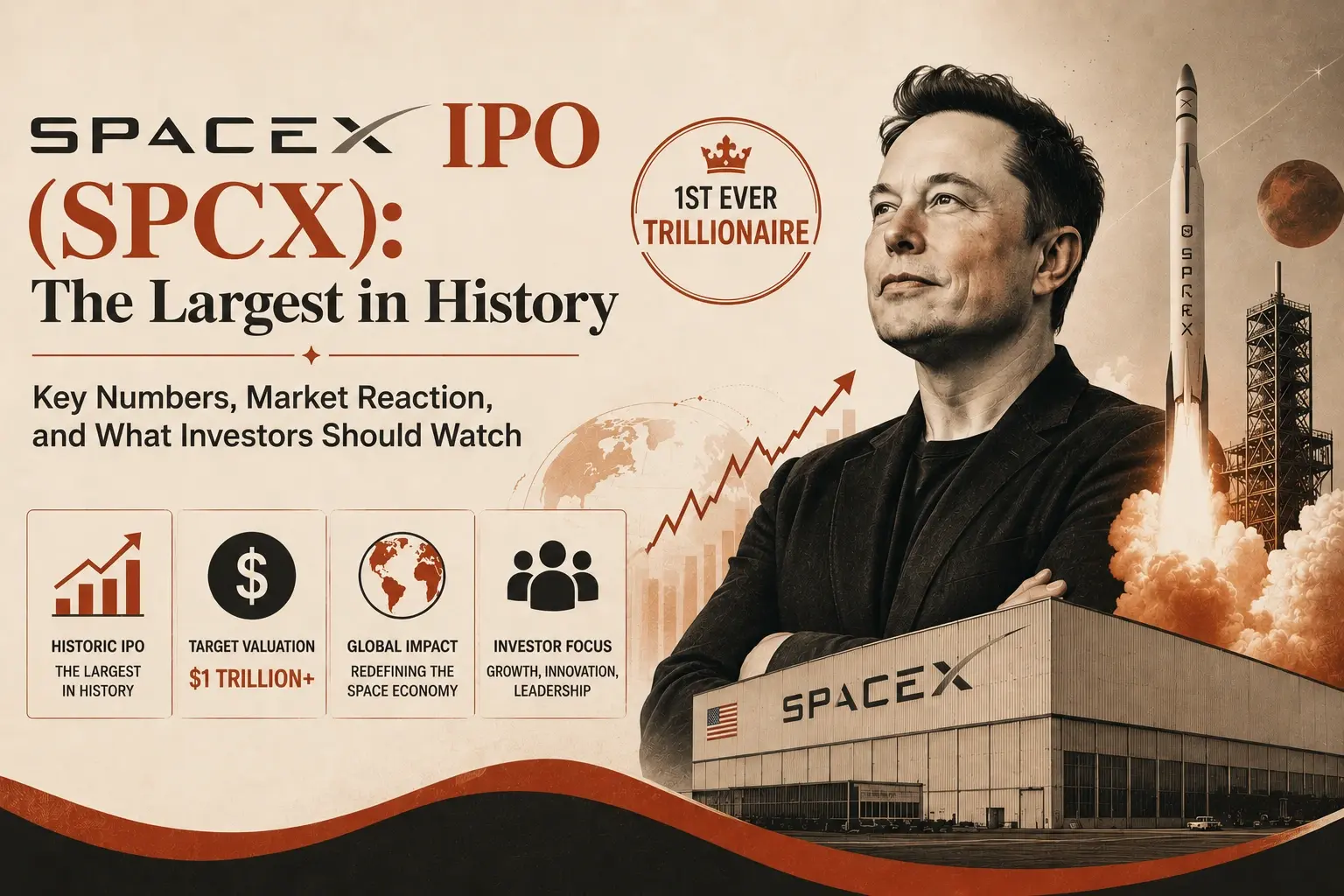
SpaceX raised $85.7B in the Largest IPO in history on June 12, 2026. Analysis of key numbers, SPCX market reaction, business model, risks, and what to watch next.
On June 12, 2026, SpaceX listed on the Nasdaq under the ticker SPCX, raising $75 billion in the largest IPO in financial history and making Elon Musk the world’s first trillionaire. Here is what happened, why it matters, and what investors should watch next.
- Largest IPO in history. SpaceX raised $75 billion at $135 per share, eclipsing Saudi Aramco’s 2019 record of $29.4 billion by more than double. After underwriters exercised a greenshoe option on June 15, total proceeds rose to $85.7 billion.
- A “Goldilocks” debut. Shares opened at $150 (+11%), hit an intraday high of $176 (+30%), and closed at $160.95 (+19%) — strong enough to reward investors, controlled enough to signal execution discipline.
- $2.1 trillion market cap on day one. Within three trading sessions, SPCX briefly surpassed Amazon to become the world’s fifth most valuable public company, touching $2.97 trillion before settling near $2.66 trillion.
- Musk becomes the first trillionaire. The listing pushed Elon Musk’s net worth above $1 trillion, a threshold no individual has crossed in recorded history.
- Two real businesses, one enormous bet. Starlink generated $11.4 billion in revenue and $4.4 billion in operating profit in 2025. The $2+ trillion valuation prices in a third business — Starship-enabled orbital AI infrastructure — that does not yet commercially exist.
What Happened?
SpaceX confidentially filed for an IPO on April 1, 2026, with 21 banks lined up for the offering. The company priced shares at $135 on the evening of June 11, at the top of an already elevated range, valuing the business at $1.77 trillion before a single share changed hands publicly. Goldman Sachs and Morgan Stanley served as lead underwriters.
When the Nasdaq opened on June 12, more than two hours of pre-market price discovery passed before SPCX shares began trading at $150 — an 11% premium to the offer price. The stock reached an intraday high of $176 by midday before settling at $160.95 at the 4 p.m. close, a 19% gain on day one. More than 510 million shares changed hands, representing roughly $84 billion in volume. The IPO attracted more than $250 billion in investor orders — oversubscribed 3.5 to 4 times — with retail investors receiving roughly 20% of IPO allocations, a notably high share for a listing of this scale.
On June 15, underwriters exercised the full greenshoe overallotment option, purchasing an additional 83.3 million shares and increasing total IPO proceeds from $75 billion to $85.7 billion.
Key IPO Numbers
| Metric | Figure |
|---|---|
| Exchange / Ticker | Nasdaq: SPCX |
| IPO Date | June 12, 2026 |
| Offer Price | $135.00 per share |
| Opening Trade | $150.00 per share (+11%) |
| Day 1 Intraday High | $176.00 per share (+30%) |
| Day 1 Close | $160.95 per share (+19%) |
| IPO Valuation | $1.77 trillion |
| Day 1 Market Cap | $2.1 trillion |
| Peak Post-IPO Market Cap | $2.97 trillion (3 days post-listing) |
| Initial Proceeds Raised | $75.0 billion (record — largest IPO in history) |
| After Greenshoe (June 15) | $85.7 billion |
| Shares Sold | 555.56 million (+83.3M greenshoe) |
| Investor Orders Received | $250+ billion (3.5–4x oversubscribed) |
| Retail Allocation | ~20% of IPO shares |
| Day 1 Volume | 510M shares (~$84 billion) |
| Lead Underwriters | Goldman Sachs & Morgan Stanley |
| Previous IPO Record | Saudi Aramco, 2019 — $29.4 billion |
Why the SpaceX IPO Matters
The SpaceX IPO is a structural event, not simply a large listing. Four things make it genuinely significant for markets and investors beyond the headlines.
It reset the ceiling for what an IPO can be. Saudi Aramco’s 2019 listing at $29.4 billion had stood as the global record for seven years. SpaceX surpassed it by more than double in a single day, and extended that further with the greenshoe. The benchmark for the next generation of mega-listings — including AI companies such as Anthropic and OpenAI, which are reportedly expected to follow later in 2026 — has been permanently reset upward.
It created the first trillionaire. Elon Musk began the day as the world’s richest person with an estimated net worth of $981 billion. He ended it at $1.1 trillion. The implications of a single individual accumulating that level of wealth — and the governance structure that allows it to compound unchecked — are being debated in financial, political, and regulatory circles simultaneously.
S&P 500 inclusion is a potential market-moving trigger. If SpaceX returns to GAAP profitability on its public financials — currently a $4.9 billion net loss in 2025 — it would qualify for S&P 500 inclusion. Analysts estimate that inclusion could compel roughly $400 billion in forced passive buying from index funds, creating significant price dislocation. That event is not imminent, but it is on the horizon.
It legitimises orbital infrastructure as an investable asset class. SpaceX is no longer a private curiosity. Every institutional investor now has to form a view on the commercial viability of Starship, orbital data centers, and direct-to-cell satellite connectivity. The IPO has forced that conversation into mainstream portfolio analysis.
Market Reaction
The debut was described by analysts as a “Goldilocks” listing: strong enough first-day gains to reward investors, controlled enough to avoid the volatility that has destabilised other high-profile IPOs. Post-listing momentum was exceptional — within three trading sessions, shares had climbed more than 60% above the offer price to touch approximately $220, briefly taking the market cap to $2.97 trillion and pushing SPCX past Amazon into the top five of the world’s most valuable public companies before settling near $2.66 trillion.
Options trading shattered records on day one: approximately 1.8 million contracts traded, generating $2.8 billion in premiums and easily surpassing Meta’s previous 2012 IPO options record of 364,000 contracts. SPCX immediately became the third most actively traded single-stock options name in the US, behind only Tesla and Nvidia.
Not all reactions were bullish. Financial analysis firm Trefis assigned a downside price target of $79.07 per share on debut day, implying a 58.78% correction from market prices, arguing that the valuation requires Starship to succeed at commercial cadence on a timeline that remains unproven.
Company Background & Business Model
Founded in 2002, SpaceX built its early business on a simple but radical insight: launch services revenue could fund the R&D to build increasingly reusable spacecraft, which would in turn lower launch costs and enable entirely new revenue streams. The company produces approximately 70% of its components in-house — engines, flight computers, ground systems — a vertical integration strategy that allows it to price a commercial Falcon 9 launch at roughly $60 million against an industry baseline of more than $400 million per mission.
As of its IPO, SpaceX operates three integrated revenue lines: launch services (Falcon 9, Falcon Heavy, and Starship in development), the Starlink satellite internet network, and Starshield (classified government communications and sensing). It also acquired Elon Musk’s AI company xAI in February 2026, and has announced a planned acquisition of AI coding startup Cursor for $60 billion, positioning itself as a combined space, satellite, and AI infrastructure business.
| Segment | 2024 Revenue | 2025 Revenue | YoY Growth | Notes |
|---|---|---|---|---|
| Starlink | $7.7B | $11.4B | +48% | $4.4B operating profit; 10M+ customers; 160 countries |
| Launch Services | $3.8B | $4.1B | +8% | 165 Falcon 9 launches; 85% of US orbital launches; 43 external customers |
| Other (Starshield / Dragon / Other) | $1.6B | $3.2B | +100% | Starshield government division; Dragon NASA missions; nascent segments |
| Total Revenue | $13.1B | $18.7B | +43% | GAAP net loss $4.9B; Adj. EBITDA $6.6B |
Starlink is already a large, profitable business. Its $4.4 billion in operating profit in 2025 funds the rest of the company’s ambitions. However, the $18.7 billion in revenue sits against a $4.9 billion GAAP net loss — driven by costs absorbed from the xAI acquisition, stock-based compensation, and $3 billion in Starship R&D spending. The $6.6 billion in adjusted EBITDA is the number bulls focus on; the $4.9 billion GAAP loss is the number that stands between SpaceX and S&P 500 index inclusion.
Opportunities and Risks
SpaceX’s addressable market extends well beyond rockets. The global space economy is projected to reach $1 trillion by 2030, and SpaceX is the only company positioned to capture multiple layers of that stack simultaneously: launch services, satellite internet (Starlink, now the world’s largest by subscriber count at 10 million+ across 160 countries), direct-to-cell connectivity (live with T-Mobile, underpinned by a $17 billion EchoStar spectrum acquisition), government and defense (Starshield, a $2 billion Pentagon Golden Dome contract, and NASA’s Artemis Human Landing System), and — if Starship delivers — orbital AI data centers powered by 24/7 solar, targeting the $200 billion cloud services market. SpaceX is also planning Terafab, a $119 billion semiconductor fabrication facility in Texas to supply chips for the planned constellation of up to one million AI satellites.
As of June 2026, Starship has completed 12 test flights with seven successes and five failures. It remains a test program. SpaceX is targeting commercial satellite launches in H2 2026. The FAA currently permits only 25 Starship launches per year from Starbase, Texas. The company’s economic model requires 70+ flights per vehicle annually at a marginal cost of roughly $2 million per launch to bring the cost of reaching orbit below $100 per kilogram. That cadence has never been demonstrated. Meanwhile, competitors are closing in: Blue Origin’s New Glenn targets the heavy-lift market, Amazon’s Project Kuiper is deploying a $10 billion LEO constellation, AST SpaceMobile is building direct-to-cell with AT&T and Verizon, and China’s CASC completed 156 launches in 2023 alone.
- Elon Musk key-person risk. SpaceX listed with a dual-class share structure: Class B shares carry 10 votes each, giving Musk and insiders permanent voting control. Public shareholders bear the full economic risk of decisions — including the $60 billion Cursor acquisition and the xAI merger — without commensurate governance rights. Musk himself has warned of a “genuine risk of bankruptcy” if Starship fails to achieve a flight rate of at least once every two weeks.
- Capital burn. SpaceX carries approximately $17 billion in combined space and AI cash burn alongside up to $119 billion in planned Terafab capital expenditure. The Starlink profit engine must continue growing to fund this ambition. Any deceleration in Starlink subscriber growth or ARPU reversal would tighten the company’s financial position materially.
- GAAP profitability and S&P 500 timing. The $4.9 billion GAAP loss in 2025 blocks immediate index inclusion. If SpaceX returns to profitability, the resulting $400 billion in estimated forced passive inflows could create severe volatility — upward on inclusion, and sharply downward if profitability is transient.
The Intelligence Edge View
The market is effectively pricing three companies as one. Company A is Starlink: a real, growing, profitable satellite internet business with 10 million subscribers, $11.4 billion in revenue, and $4.4 billion in operating profit. By itself, Starlink is worth several hundred billion dollars — perhaps approaching $1 trillion at aggressive growth multiples. The IPO already justified itself on this basis alone.
Company B is Falcon 9: a dominant but maturing launch services franchise. Revenue growth has slowed to 8% year-on-year as the majority of launches are now internal Starlink deployments rather than commercial customers. This is a quality problem to have, but it is not the growth engine the $2+ trillion valuation requires.
Company C is Starship: an unproven rocket that, if it works at commercial cadence and acceptable cost, could reduce the price of reaching orbit by 27 times relative to Falcon 9, unlock orbital AI data centers, and transform SpaceX into the defining infrastructure company of the next decade. The market is pricing Company C at near-full optimism today. The Trefis downside target of $79 — implying a 58% correction — is essentially a “Company A only” valuation if Starship underdelivers.
Our view: the underlying thesis is credible and the long-term strategic positioning is genuine. But at current prices, investors are being asked to pay a premium for execution that has not yet been demonstrated at scale. This is a name to watch carefully through H2 2026 as Starship moves from testing to its first commercial launches. The inflection point is real — but the market has priced it as already arrived.
What Investors Should Watch Next
- Starship commercial launch cadence (H2 2026 target). SpaceX is targeting its first commercial Starship satellite launches in the second half of 2026. Success would mark the first time Starship generates meaningful revenue and provide the data point the bull case requires. Failure or delay would force a material valuation reassessment. Watch FAA launch authorization updates and SpaceX cadence announcements closely.
- First public earnings report. SpaceX’s first quarterly results as a public company will be the most scrutinised earnings release of 2026. Investors will be focused on Starlink subscriber growth, ARPU trajectory, the GAAP loss vs. adjusted EBITDA gap, and any updated guidance on the Starship commercial timeline. Any disclosure on xAI and Cursor integration costs will move the stock.
- S&P 500 GAAP profitability trigger. A path back to GAAP profitability — requiring SpaceX to either strip out xAI-related losses or grow revenue fast enough to absorb them — is the key catalyst for index inclusion. Monitor quarterly adjusted EBITDA progression and management commentary on the timeline for consolidated GAAP profitability.
- Competitive developments in LEO broadband. Amazon’s Project Kuiper deployment cadence and its $11.57 billion Globalstar acquisition are the primary threats to Starlink’s network effects lead. Any acceleration in Kuiper subscriber acquisition or pricing competition would apply direct pressure to Starlink’s ARPU and growth trajectory, with direct valuation implications for SPCX.
Frequently Asked Questions
Is SpaceX publicly traded?
Yes. SpaceX listed on the Nasdaq on June 12, 2026, under the ticker symbol SPCX. Prior to that date the company had been entirely private since its founding in 2002. The IPO priced at $135 per share, raised $75 billion (later $85.7 billion after the greenshoe option was exercised), and marked the largest initial public offering in financial history.
How much did SpaceX raise in its IPO?
SpaceX initially raised $75 billion — the largest IPO in history, surpassing Saudi Aramco’s $29.4 billion in 2019 by more than double. On June 15, 2026, underwriters Goldman Sachs and Morgan Stanley exercised a full greenshoe overallotment option, purchasing an additional 83.3 million shares and bringing the total proceeds to $85.7 billion.
What is SpaceX’s market cap?
At its IPO offer price of $135, SpaceX was valued at approximately $1.77 trillion. Shares closed on day one at $160.95, implying a market cap of $2.1 trillion. Within three trading sessions the stock had climbed to approximately $220, briefly pushing the market cap to $2.97 trillion and taking SPCX past Amazon as the world’s fifth most valuable public company. Current valuation can be tracked via the live chart above.
Is SpaceX profitable?
SpaceX’s Starlink division is highly profitable, generating $4.4 billion in operating profit on $11.4 billion in revenue in 2025. However, the company reported a GAAP net loss of approximately $4.9 billion for 2025 as a whole, driven by costs absorbed from the xAI acquisition, stock-based compensation, debt, and $3 billion in Starship R&D. Adjusted EBITDA for 2025 was $6.6 billion. The GAAP loss is the primary hurdle to S&P 500 index inclusion.
What is SpaceX’s stock ticker and where does it trade?
SpaceX trades under the ticker SPCX on the Nasdaq exchange. The company executed a 5-for-1 stock split in May 2026 ahead of its listing, adjusting the per-share price from approximately $526 to $105 before the final IPO pricing at $135.
What is the Elon Musk key-person risk for SpaceX investors?
SpaceX listed with a dual-class voting structure: Class B shares carry 10 votes each and are held by Elon Musk and insiders. This gives Musk effective permanent voting control over the company; he cannot be removed as CEO or chairman without the consent of Class B holders he already controls. Public shareholders bear the economic risk of decisions — including major acquisitions such as xAI and Cursor — without proportionate governance rights. This structure is disclosed in the IPO prospectus and is a material risk factor.
Sources & Disclosures
- The Guardian — “Elon Musk becomes world’s first trillionaire as SpaceX ends trading day with valuation of $2.1tn,” June 12, 2026
- Reuters — “SpaceX raises $85.7 billion after underwriters exercise greenshoe option,” June 15, 2026
- PL Capital — “SpaceX IPO: Key Records and Milestones Behind the Company’s Market Debut,” June 17, 2026
- The Guardian — “SpaceX has overtaken Amazon to become world’s fifth most valuable company,” June 17, 2026
- Sacra — SpaceX Revenue Model and Business Analysis, updated May 2026
- Trefis — SpaceX (SPCX) valuation analysis and price target, June 16, 2026
- Live price data via TradingView
This article is for educational and informational purposes only and is not investment advice; do your own due diligence and consult a qualified financial advisor before making any investment decision.