Oil Has Fallen Faster Than Geopolitical Risk-But Is The Market Pricing the Right Risk?
By The Intelligence Edge Research Team · June 28, 2026 · 36 min read
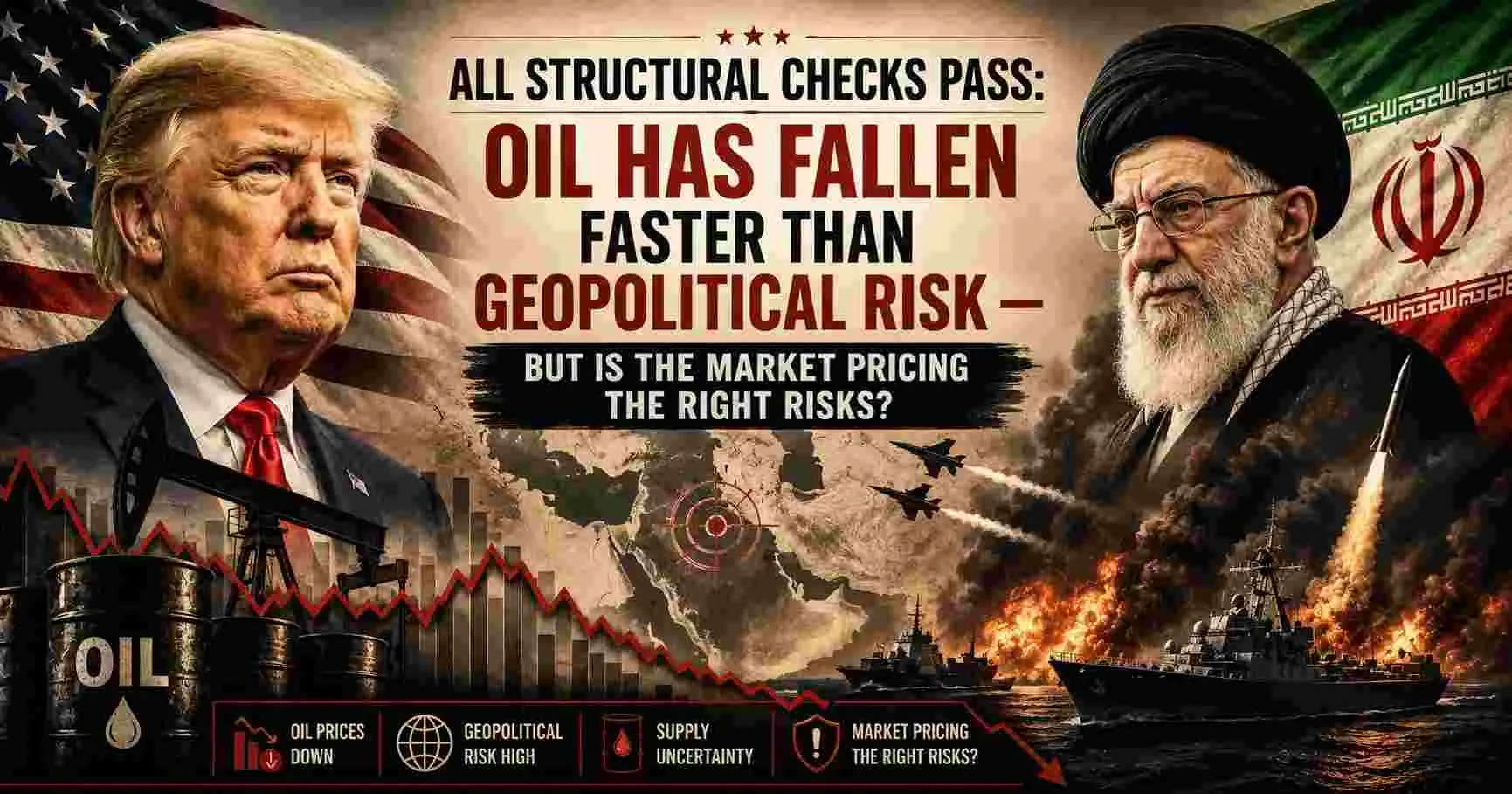
Oil priced the war as over. Then the US struck Iran again, and the ceasefire collapsed into a market with no barrels of safety left.
Update — 13 July 2026
The escalation this analysis warned about has fully arrived — and yet the repricing has not. On 7–8 July the US Treasury revoked Iran's oil-export waiver six weeks ahead of its deadline, three commercial vessels were struck inside the Strait of Hormuz, the US hit more than eighty targets inside Iran, and President Trump declared the ceasefire "over" at NATO's Ankara summit. Brent, however, settled near $76 — a fraction of the $95–130 band our Renewed Escalation scenario implied.
Why the market still hasn't repriced — and what would finally move it — is the subject of our follow-up analysis: Part 2 — We Called the Escalation. It Happened. Oil Still Hasn't Priced It.
Breaking update — 28 June 2026
The pause has broken. Hours after this analysis was filed, the United States struck Iran for a second day — and the market's complacency, the subject of everything below, has been overtaken by events.
After an Iranian drone hit the tanker MT Kiku — carrying more than two million barrels — near the Strait of Hormuz, US fighter jets struck ten Iranian military targets in and around the strait. Iran retaliated with ballistic missiles and drones against US forces in Bahrain and Kuwait, sounding air-raid sirens across the Gulf. The 17 June ceasefire has effectively collapsed, and the sanctions waiver that revived Iranian exports is expected to terminate.
The analysis that follows was written as Brent sat at a four-month low of $72.71, with the market pricing the war as over. It explains, in detail, precisely why that calm was an illusion — and why a market stripped of every barrel of safety was set up for exactly the violent repricing now underway.
Brent has surrendered its entire wartime risk premium in a matter of weeks. The forward curve says the crisis is over. The physical market — drained inventories, a contested ceasefire, a strait still half-closed — is telling a very different story. This is an investigation into which one is right.
By almost every measure a trader watches on a screen, the Middle East crisis of 2026 is finished. Brent crude has erased nearly all of its wartime gains, settling at roughly $72.71 on 26 June — a four-month low. Oil volatility has collapsed from its springtime extremes. Tankers are loading at Kharg Island again. Equity markets, which buckled in March, have stopped caring entirely.
There is only one problem. Almost none of the geopolitical questions that started the war have actually been answered. Iran's nuclear program remains unresolved. The Strait of Hormuz is governed by a "deconfliction channel" that an Iranian gunboat violated nine days ago. Israel is not a party to the agreement that supposedly ended the fighting on its northern border. The United States lifted a naval blockade in exchange for a 60-day waiver that the two signatories already describe in contradictory terms. And the global oil-storage cushion that is supposed to absorb the next shock has been drawn down to its thinnest level since 2003.
So here is the question this article exists to investigate: when oil fell faster than the geopolitical risk that caused it to rise, was the market correctly pricing peace — or was it pricing something far more fragile, and calling it peace?
- Oil round-tripped a war. Physical crude approached $150 a barrel in March; the September futures contract now trades near $73. The round trip happened faster than any of the underlying risks were resolved.
- The selloff was mechanical, not fundamental. The evidence points to forced liquidation by leveraged funds, algorithmic trend-following, and a 2027-surplus narrative — not to the disappearance of supply risk.
- The buffers are gone. OECD inventories are heading toward roughly 50 days of demand cover, the lowest on record. The US Strategic Petroleum Reserve sits at a four-decade low. The market has no industrial margin of safety left.
- The overlooked bull case is a tail risk nobody is hedging in the open. With near-zero spare capacity and empty storage, even a modest disruption now becomes a volume shock, not just a price shock.
- The overlooked bear case is the opposite of intuition. If sanctions relief becomes permanent, Iranian barrels and a Saudi fight for market share could push prices lower than the consensus dares to model. Successful diplomacy may be the most bearish outcome of all.
- Risk premium
- The extra amount built into a price to compensate for the chance of a disruptive event — here, the "war premium" that has now been priced out of oil.
- Backwardation / contango
- A downward-sloping futures curve (later barrels cheaper than nearer ones) is backwardation, signalling expected ample supply; an upward slope is contango, signalling expected tightness or storage demand.
- Days of cover
- How many days stored inventory would meet demand if supply stopped today — the global fuel tank measured in time rather than barrels.
- Spare capacity
- Oil production that can be brought online quickly and sustained — the market's shock absorber. At 320 kb/d, it is effectively spent.
- Shadow fleet
- Tankers operating with opaque ownership and insurance to move sanctioned crude, principally Iranian oil bound for China.
- Strait of Hormuz
- The chokepoint between Iran and Oman through which roughly a fifth of the world's oil passes; its security is the single largest swing factor in this market.
Act I — The Disappearance of Fear
A fall of more than $40 a barrel in a matter of weeks is not a drift. It is a stampede. And like any stampede, it had more than one animal in it. Before we can judge whether the market is right, we have to know what actually moved it — so let us treat the selloff the way an investigator treats a crime scene, by lining up the suspects and eliminating them one at a time.
Suspect one: collapsing demand. This one has real fingerprints. In its June Oil Market Report, the International Energy Agency did something it rarely does — it forecast that global oil demand would contract in 2026, by roughly 1.1 million barrels a day. High pump prices, refined-product scarcity and government fuel-saving measures did genuine damage, especially across Northeast Asia. China's vast petrochemical complex, starved of Gulf naphtha and LPG when Hormuz closed, saw feedstock imports fall by as much as 75%. Demand destruction is real, and it is bearish. But note the timing: the demand picture deteriorated during the war, when prices were high — not in June, when they collapsed. Demand is a motive, but it is not the trigger.
Suspect two: OPEC+ supply. On paper, the cartel agreed in April to unwind a further 206,000 barrels a day of cuts. But "on paper" is the operative phrase. As we will see, the group's effective spare capacity had by then collapsed to almost nothing. OPEC+ did not flood the market in June. It could not have if it tried. Eliminated.
Suspect three: a stronger dollar and softer macro. A contributing factor, always. But the dollar's move was not large enough to explain a 35% price decline. An accessory, not the principal.
Suspect four: diplomacy. Here is where the market's story lives. The US–Iran Memorandum of Understanding, signed in Geneva on 17 June, lifted the naval blockade and opened a 60-day window for Iranian exports. The headline writes itself: war over, risk gone, sell. But a memorandum is not a peace treaty, and — as the second half of this article will show — the two sides cannot even agree on what they signed.
Suspect five: speculative and algorithmic flow. This is the suspect holding the smoking gun. According to CFTC positioning data, leveraged money managers did not gently rotate out of oil; they capitulated. Net-long positions in both Brent and WTI were liquidated en masse. And crucially, this was accelerated not by a calm reassessment of fundamentals but by a sharp rise in exchange margin requirements and by algorithmic trend-followers selling into the move. When margin calls hit leveraged books, the trade is not "I believe the war is over." The trade is "I have no choice but to reduce."
This distinction matters more than any single price print. A market that falls because the fundamental risk has genuinely receded is a market you can trust. A market that falls because leveraged players were forced out by margin mechanics is a market that has moved for reasons that have nothing to do with whether the next missile gets fired.
The June selloff was, in large part, the second kind. It was a deleveraging event wearing the costume of a peace rally.
So if the war's central questions remain unresolved, and the selloff was driven as much by margin clerks as by diplomats — what, exactly, did the market just price out? To answer that, we have to put the market's confident narrative side by side with the evidence.
Act II — The Narrative Versus the Evidence
Every large price move comes wrapped in a story the market tells to justify it. In June 2026 that story had five chapters, each one comforting, each one repeated across trading desks until it hardened into consensus. The trouble is that for every chapter of the narrative, the documented evidence points the other way.
| The market narrative | What the evidence shows |
|---|---|
| "The conflict is over." | The nuclear question is untouched. Iran denies making any new commitment on IAEA inspections. |
| "Hormuz is safe again." | The strait reopened under an unstable deconfliction channel — and an IRGC vessel attacked commercial shipping on 25 June. |
| "Supply will normalize." | OECD inventories are heading to their lowest level since 2003. There is nothing to normalize from. |
| "Iran is isolated." | Iranian exports are already recovering — 54 shadow-fleet tankers were tracked reloading in late June. |
| "Diplomacy solved the risk." | Israel is not a party to the agreement and says its forces will keep operating in Lebanon. |
Read that table twice. Each row on the left is something a reasonable person heard on financial television in June. Each row on the right is documented in the primary record — IEA inventory data, EIA storage figures, Institute for the Study of War field reports, UANI tanker tracking. The gap between the two columns is the story.
Take the single most important row: inventories. Across the war, the world burned through its emergency cushion at a staggering pace — global stocks were drawn down at an average of 3.8 million barrels a day, accelerating to a record 4.6 million in May alone. The US Strategic Petroleum Reserve has fallen to around 331–340 million barrels, its lowest in more than four decades. The IEA has already deployed nearly half of its 400-million-barrel emergency reserve. The buffer that is supposed to protect the global economy from the next shock has largely been spent fighting the last one.
Inventory is often quoted in days of demand cover — how long stored oil would last if supply stopped today. Think of it as the global fuel tank measured in days, not barrels. Heading toward 50 days, the tank is as empty as it has been this century. Below a certain point, pipelines and refineries cannot keep flowing: a portion of inventory is not a buffer at all but the minimum needed to keep the system pressurized.
If global inventories are draining toward a two-decade low, why is the market behaving as though supply risk has simply disappeared?
That is not a rhetorical flourish. It is the precise contradiction at the heart of this market. To resolve it, we have to stop looking at prices and start looking at the four questions the price is quietly assuming it knows the answer to.
Act III — The Four Investigations
The market's calm rests on four beliefs about the geopolitics of the war. Each one deserves to be tested against evidence rather than accepted as a headline. Treat what follows not as opinion but as four short investigations — each starting from a question the consensus thinks is already settled.
Investigation One — Did the military campaign actually change Iran's strategic position?
The United States did not fight a limited skirmish. Beginning on 28 February, it launched Operation Epic Fury, a heavy air campaign aimed at degrading Iran's military. When Pakistani-mediated ceasefire talks collapsed in April, Washington escalated to a full naval blockade of Iranian ports — authorizing its forces to stop, search and seize any vessel suspected of carrying Iranian crude. For a few weeks, it worked spectacularly: Iranian oil and petrochemical exports fell more than 90% in May, and for a period no crude at all cleared the blockade.
And yet. By late June, with the blockade lifted, UANI was already tracking 54 tankers reloading along the Iranian coast and at least eleven major liftings from Kharg Island. Iran's onshore storage had been full enough that production barely fell — output held near 3.4–3.6 million barrels a day throughout. The campaign inflicted enormous short-term pain. It did not remove Iran's oil from the board; it merely paused it.
Most analysts focus on how much oil Iran can produce. After this war, that may be the wrong variable. The number that matters is how much Iran has already stored — because barrels in a tank can hit the market in days once the political gate opens, with no drilling, no ramp-up and no warning. Iran spent the blockade filling tanks. That inventory is a loaded spring.
Verdict: The military campaign changed Iran's cash flow, not its strategic position. The leverage that made Iran dangerous — its hand on the Strait of Hormuz and a wall of stored crude — survived the war intact.
- 28 FEB 2026Operation Epic Fury beginsUS strikes on Iran. Oil spikes as a risk premium floods in.
- 19 MAR 2026Hormuz effectively closedDubai crude hits $167.62; physical benchmarks approach $150.
- 13 APR 2026US naval blockade imposedPakistani-mediated talks collapse. Iranian exports begin to crater.
- 01 MAY 2026UAE formally leaves OPECGulf energy politics fracture; spare capacity already near zero.
- 17 JUN 2026US–Iran Memorandum signed (Geneva)Blockade lifted; 60-day waiver. Oil collapses toward $73.
- 25 JUN 2026IRGC attacks a commercial vessel off OmanDeconfliction protocol violated — the market barely flinches.
- 28 JUN 2026Ceasefire collapses — US strikes Iran againDrone hits the tanker MT Kiku; US strikes 10 targets near Hormuz; Iran fires on US bases in Bahrain & Kuwait. Oil set to reprice violently higher.
- 07 JUL 2026Waiver revoked; tankers struck in the straitThe US Treasury ends the oil waiver six weeks early; the LNG carrier Al Rekayat and the supertanker Wedyan are hit; the US strikes 80+ targets inside Iran.
- 08 JUL 2026Trump declares the ceasefire "over"A third vessel is hit; Iran strikes US-linked sites in Bahrain and Kuwait. Brent settles near $76 — the muted repricing examined in Part 2.
Investigation Two — Why did markets celebrate the agreement, and was the celebration justified?
On the surface, the 17 June memorandum looks like the moment risk left the building: a ceasefire on all fronts, the blockade lifted, Iran agreeing to "open" the Strait of Hormuz, and a 60-day US Treasury waiver (General License X) letting Iranian crude flow again. The market took it at face value and sold the premium.
But read the fine print — or rather, notice that there is no agreed fine print. The full text was never published, and US and Iranian officials describe the same document in incompatible terms. Vice-President J.D. Vance said the strait would be open "in a toll-free way for the long term." Iranian state media said Tehran was merely pausing fees for 60 days and intended to resume charging "service fees" — while jointly managing the waterway with Oman, a claim of sovereignty over an international strait. Washington said sanctions relief was conditional on Iranian compliance; Tehran said relief was owed immediately. Trump said Iran had agreed to nuclear inspections; Iran flatly denied making any new commitment.
The most authoritative skeptic is not a hedge-fund manager but a regional scholar. Carnegie's Karim Sadjadpour has called the deal a "Memorandum of Misunderstanding" and argued the United States "spent tens of billions of dollars, and upended the global economy, only to sign a memorandum weaker than any deal it could have struck before the war."
This is where the war's most consequential shift hides. The administration's pivot — from maximal military pressure to a hastily signed truce — did not just end a conflict; it rearranged the regional board. Iran emerged with its Hormuz leverage formally acknowledged in a bilateral channel. The UAE walked out of OPEC. And the new Lebanon "deconfliction cell" includes Iran but excludes Israel, stripping away the mechanism through which Israel previously addressed Hezbollah violations.
For an oil market, the implication is uncomfortable. A deal built on two contradictory interpretations is not a settlement; it is a scheduled disagreement. The 60-day waiver does not remove risk. It puts a clock on it.
Verdict: The celebration priced a peace that the signatories themselves do not agree they signed. The relief rally rested on a document read two different ways in two capitals.
Investigation Three — Could peace actually be bearish for oil?
Here is the counterintuitive heart of the whole story — the scenario almost nobody is positioned for, because it inverts the reflex that says "Middle East tension equals higher oil." What if the genuinely bearish outcome is not war, but successful diplomacy?
Consider the mechanics. Before the war, Iran exported around 1.8 million barrels a day, the overwhelming majority to China, moved by a shadow fleet built to dodge sanctions. The blockade severed that. But the 60-day waiver has already reactivated it, and if relief becomes permanent — the natural endpoint of the diplomatic track the market is cheering — those barrels return in full, joined by the crude Iran stockpiled during the blockade.
Now add the Saudi question. If Iranian supply floods back, does Riyadh quietly cut to defend the price, as it has in past cycles? Or, with the UAE having just quit OPEC and Gulf cohesion fracturing, does it instead defend market share — and let prices fall to squeeze higher-cost rivals? A cartel that has lost a member and its spare capacity is a cartel with far less ability to manage a glut.
Verdict: The same diplomatic breakthrough the market is celebrating as risk-off contains, inside it, a genuinely bearish supply shock. Investors cheering the peace may be cheering the very thing that takes oil meaningfully lower. This is the bet nobody is hedging.
Investigation Four — Is this agreement actually stable? The fragility test
Every assumption above depends on one thing: that the 17 June memorandum holds. So run it through a fragility test, pressure point by pressure point.
Israel. Not a signatory. Its forces continue operating against Hezbollah in southern Lebanon, and the new monitoring cell that excludes it gives Iran a faster channel to shape the narrative on every alleged violation. The most militarily active player in the theatre is outside the deal.
Iran. Has made no verified nuclear concession, insists on its own reading of Hormuz sovereignty, and — per ISW — may use any unfrozen funds to reconstitute military capability rather than buy the US agricultural goods Washington floated.
The proxies. Hezbollah is rebuilding under the ceasefire. The IRGC has embedded officers in Lebanon. The structures that produced the war are still in place.
The clock. The waiver expires on 21 August. After that, every contested clause — fees, sanctions, inspections — comes due at once.
And the test already has a data point. On 25 June, just days after the signing, an IRGC vessel attacked a commercial ship off Oman, violating the deconfliction protocol outright. The market's response was a shrug.
Verdict: The agreement was never a resolution — only a 60-day pause resting on five fault lines and a violation that had already occurred. That verdict was written on 27 June. On 28 June it was confirmed: the US struck Iran again, Iran fired on American bases across the Gulf, and the pause shattered. The Fragility Test was not hypothetical. It was a countdown.
Act IV — What the Price Actually Assumes
A price is a bundle of assumptions. When Brent trades at $73 rather than $90 or $55, it is not making a prediction so much as quietly betting on a specific set of conditions all holding at once. Strip the bundle apart, and the bets look far less safe than the calm tape suggests.
Assumption: Hormuz stays open and safe. Yet it reopened under a fragile channel that was violated within days, and shipping companies — per Reuters' reporting of shipper sentiment — want full confirmation of safety before fully resuming, with mine-clearing estimated at 40–50 days. Challenged.
Assumption: the memorandum holds past August. Yet the two signatories cannot agree on what it says. Challenged.
Assumption: OPEC can offset any new disruption. Yet effective spare capacity is 320,000 barrels a day — a rounding error against the 15 million barrels lost at the peak of this war. Eliminated.
Assumption: inventories will rebuild as a backstop. Yet they are at a two-decade low with no industrial margin of safety. Eliminated.
Assumption: demand stays soft enough to keep the market loose. This one, at least, has support — and it deserves a fair hearing rather than a straw man.
The strongest case for the bears — stated fairly
Not every analyst pricing oil near $73 is complacent. There is a serious, evidence-based argument that the market is correctly priced, and intellectual honesty requires putting it at full strength. It runs like this: the IEA itself forecasts a 1.1-million-barrel-a-day demand contraction in 2026 and projects global supply surging by roughly 8 million barrels a day in 2027, toward 110.3 million. On that view, the world is tipping into a structural surplus, the war was a transitory spike, and fading the risk premium is simply correct. The futures curve agrees.
A forward curve that slopes downward — later barrels cheaper than nearer ones — is called backwardation, and it usually signals a market that expects to be well supplied later on. The Brent curve shows a slight premium at the very front (a hint of present tightness) giving way to backwardation further out. Translation: traders see tightness today but bet on glut tomorrow. The entire bearish case lives in that downward slope.
So who is right — the surplus bears or the depleted-buffer bulls? The honest answer is that the market is being asked to hold both truths at once, and is resolving the tension by listening only to the half it finds comfortable. The clue that it knows this is buried in the options market.
Headline volatility has fallen. But beneath it, traders are loading up on deep out-of-the-money call options — cheap bets that pay off only if oil spikes violently higher. In other words, the same institutions selling the front-month and pocketing the calm are quietly paying for insurance against the calm being wrong. The body language of the market contradicts its own narrative. It says "peace" out loud and buys upside protection in a whisper.
Act V — Follow the Money
Investigations end where the money leads. Strip away the geopolitics and two cleanly opposed outcomes remain — durable détente or a broken truce — and each one redistributes wealth across the market in a predictable way. This is not a set of stock tips; it is a map of who sits on which side of the trade.
- China & India — cheap discounted Iranian crude returns to their refiners.
- Refiners & petrochemicals — feedstock costs fall, cracks widen as products reflow.
- Airlines & logistics — lower jet fuel and diesel ease the largest variable cost.
- Consumers & central banks — softer energy eases headline inflation and rate pressure.
- Under pressure: Saudi market share, US shale economics, and anyone long the premium.
- Defense — renewed escalation reprices the entire sector.
- Integrated oil majors — leverage to a fresh spike with intact production.
- Tanker owners — rerouting and risk send day-rates sharply higher.
- Marine insurers & commodity traders — volatility and war-risk premiums are the product.
- Losers: airlines, emerging-market importers, and consumers facing a fresh inflation pulse.
Notice the symmetry. The list of winners on the left is, almost line for line, the list of losers on the right. That is not a coincidence — it is the signature of a market sitting on a fault line, where the same asset is a brilliant buy in one future and a painful hold in the other. Which is exactly why the next section refuses to pick one.
Three Scenarios for the Next Quarter
Forecasting a single oil price into this fog would be false precision. Far more useful is to frame the distribution of outcomes, attach rough and clearly subjective probabilities, and let the reader weigh the path that seems most credible. These are scenario sketches, explicitly labelled as such — author analysis, not consensus, and certainly not advice.
Think of the percentage as our honest best guess at the odds, like a forecaster saying "70% chance of rain" — not a certainty, but a guide to how to plan. The ranges are Brent levels, not targets. The probabilities sum to a band rather than exactly 100% because the scenarios are not perfectly exclusive.
The truce holds uneasily; flows partly normalize but the strait stays a permanent headline risk. Thin buffers keep a floor under prices even as surplus fears cap them — a market that trades in a range, punctuated by scares. Refiners, consumers and range-traders do best; inflation eases gradually rather than cleanly.
The waiver lapses or the deconfliction channel fails; Hormuz is disrupted again. It bites harder now than it did in March: zero spare capacity and empty storage turn a price shock into a volume shock. Defense, oil majors, tankers and insurers win; central banks face a fresh global inflation pulse with little room to respond. The repricing math is unforgiving: the World Bank estimates that in high-risk periods a 1% supply loss drives an 11%+ peak price spike, and a Hormuz impasse pushes crude past its $150 wartime peak.
Relief becomes permanent; stored and shadow-fleet barrels flood back just as the IEA projects a 2027 supply surplus and Saudi Arabia defends market share rather than price. The irony writes itself: successful diplomacy delivers the most bearish outcome of all. Importers, airlines and disinflation trades win; it is a genuine downside surprise.
Probabilities are the author's subjective estimates for framing only, not statistical forecasts.
The Revelation
Return, finally, to the question we started with: when oil fell faster than the risk that drove it up, was the market pricing peace?
The evidence says no. It was pricing something narrower and far more brittle. The nuclear file is open. The strait is governed by a contested channel that has already been violated. Israel sits outside the agreement. The buffers are empty, the cartel has lost a member and its spare capacity, and a 60-day clock is ticking toward August. None of that is the architecture of peace. It is the architecture of a pause.
Markets are not pricing peace. They are pricing temporary stability — and calling it peace.
That single substitution explains everything that looks contradictory about this market: the calm front-month and the panic-buying of upside calls; the falling price and the falling inventories; the relief rally over a memorandum its own signatories cannot agree on. The market is not mispricing one risk. It is trying to price two opposite futures — a diplomatic breakthrough that floods the world with Iranian oil, and a broken truce that sends crude vertical — at the same time, in the same number.
For the professional investor, the takeaway is not a price target. It is a reframing. The job over the next quarter is not to guess where oil settles. It is to judge which of those two futures became more probable this week — and to notice that the market, by drawing down its last barrels of safety while declaring victory, has left itself no room to be wrong.
What to Watch Next
Headlines will mislead. These indicators will not — each one is a direct readout of whether the pause is holding or breaking.
- The August waiver clock. Whether General License X is extended, expanded or allowed to lapse on 21 August is the single highest-signal event on the calendar.
- War-risk insurance premiums for Gulf shipping. The truest market price of Hormuz risk — and slower to lie than futures.
- The options call skew (CVOL and out-of-the-money calls). If institutions keep paying up for upside protection, the "peace" is not believed by the people hedging it.
- OECD and US inventory builds. Until the cushion rebuilds, every disruption is amplified. Watch the days-of-cover trend, not just the weekly barrel number.
- Iranian export tonnage (tanker tracking). The real-time test of Investigation Three — how fast the stored barrels actually return.
- CFTC positioning. Whether money managers rebuild longs, or commercial hedgers and speculators keep diverging — often a precursor to the next reversal.
Frequently Asked Questions
Why did oil fall if the geopolitical risks aren't resolved?
Largely because of market mechanics rather than fundamentals. Leveraged funds were forced to liquidate long positions by rising margin requirements and algorithmic trend-following, while a 17 June US–Iran memorandum gave the selloff a narrative. The underlying risks — Hormuz, the nuclear file, Israel's exclusion, empty inventories — remain live.
Is the war between the US and Iran actually over?
No — and it has since collapsed completely. After reigniting on 28 June, the breakdown was confirmed on 7–8 July: the US Treasury revoked the sanctions waiver outright, three commercial vessels were struck inside the strait, and President Trump declared the ceasefire "over" at the NATO summit in Ankara. Part 2 of this series grades this article's scenario against those events.
Could oil really go lower from here?
Yes — and counterintuitively, the trigger could be successful diplomacy. If sanctions relief becomes permanent, Iranian barrels (including crude stored during the blockade) flood back just as the IEA projects a 2027 supply surplus and a Saudi fight for market share. That combination could take Brent into the $45–$60 range in the most bearish scenario.
Could oil spike again?
Also yes, and more violently than before. With OPEC+ spare capacity at a record-low 320,000 barrels a day and inventories at a two-decade low, the system has no shock absorber left. A renewed Hormuz disruption would become a volume shock, plausibly pushing Brent above $95–$130.
Why do empty inventories matter so much?
Inventories are the global economy's buffer against supply shocks. Drawn down to roughly 50 days of cover — the lowest since 2003 — with the US SPR at a four-decade low, there is almost nothing left to release in an emergency. A portion of remaining stock isn't even usable; it is the minimum needed to keep pipelines and refineries flowing.
Is this article investment advice?
No. It is an analytical framework for thinking about risk, not a recommendation to buy or sell any security or commodity. The scenarios and probabilities are the author's subjective analysis. Do your own due diligence and consult a qualified financial adviser before making any investment decision.
- We Called the Escalation. It Happened. Oil Still Hasn't Priced It. — Part 2 of this series: grading this article's Renewed Escalation scenario against what actually happened, and why Brent still hasn't caught up.
- H2 2026: The Three Risks We're Watching — Oil, AI, and the Debt Wall — how the depleted oil market fits alongside AI concentration and the debt wall.
This analysis distinguishes throughout between documented fact, market consensus, market-implied pricing, and the author's own analysis and scenario work. Figures are current as of 28 June 2026; the 13 July update box, timeline entries and scenario status reflect events through 13 July 2026, analysed in full in Part 2. It draws on:
- International Energy Agency — Oil Market Report (April, May, June 2026): demand contraction, supply balances, Iranian production and exports, spare capacity.
- US Energy Information Administration — Short-Term Energy Outlook (June 2026) and Weekly Petroleum Status Report: OECD days-of-cover, US commercial and SPR inventories.
- OPEC — Monthly Oil Market Report (May 2026) and JMMC communiqués: production policy and quota decisions.
- Institute for the Study of War — Iran Update Special Reports (15–25 June 2026): MoU interpretation, Hormuz, the Lebanon deconfliction cell, the 25 June maritime incident.
- Al Jazeera live coverage (28 June 2026) — US strikes on Sirik, Qeshm Island and Bandar-e Lengeh; the MT Kiku tanker attack; Iranian retaliation against US forces in Bahrain and Kuwait; ceasefire status.
- Carnegie Endowment / Malcolm H. Kerr Carnegie Middle East Center — Karim Sadjadpour commentary on the US–Iran agreement.
- United Against Nuclear Iran (UANI) — Iran tanker tracking and shipping updates (June 2026).
- ICE Brent and NYMEX WTI futures; CME Group CVOL; CFTC Commitments of Traders — price, curve, volatility and positioning data.
This article is for educational and informational purposes only and is not investment advice. It does not constitute a recommendation to buy or sell any security, commodity or financial instrument. Markets are volatile and you can lose money. Do your own due diligence and consult a qualified financial adviser before making any investment decision.