H2 2026: The Three Risks We're Watching — Oil, AI, and the Debt Wall
By The Intelligence Edge Research Team · June 29, 2026 · 19 min read
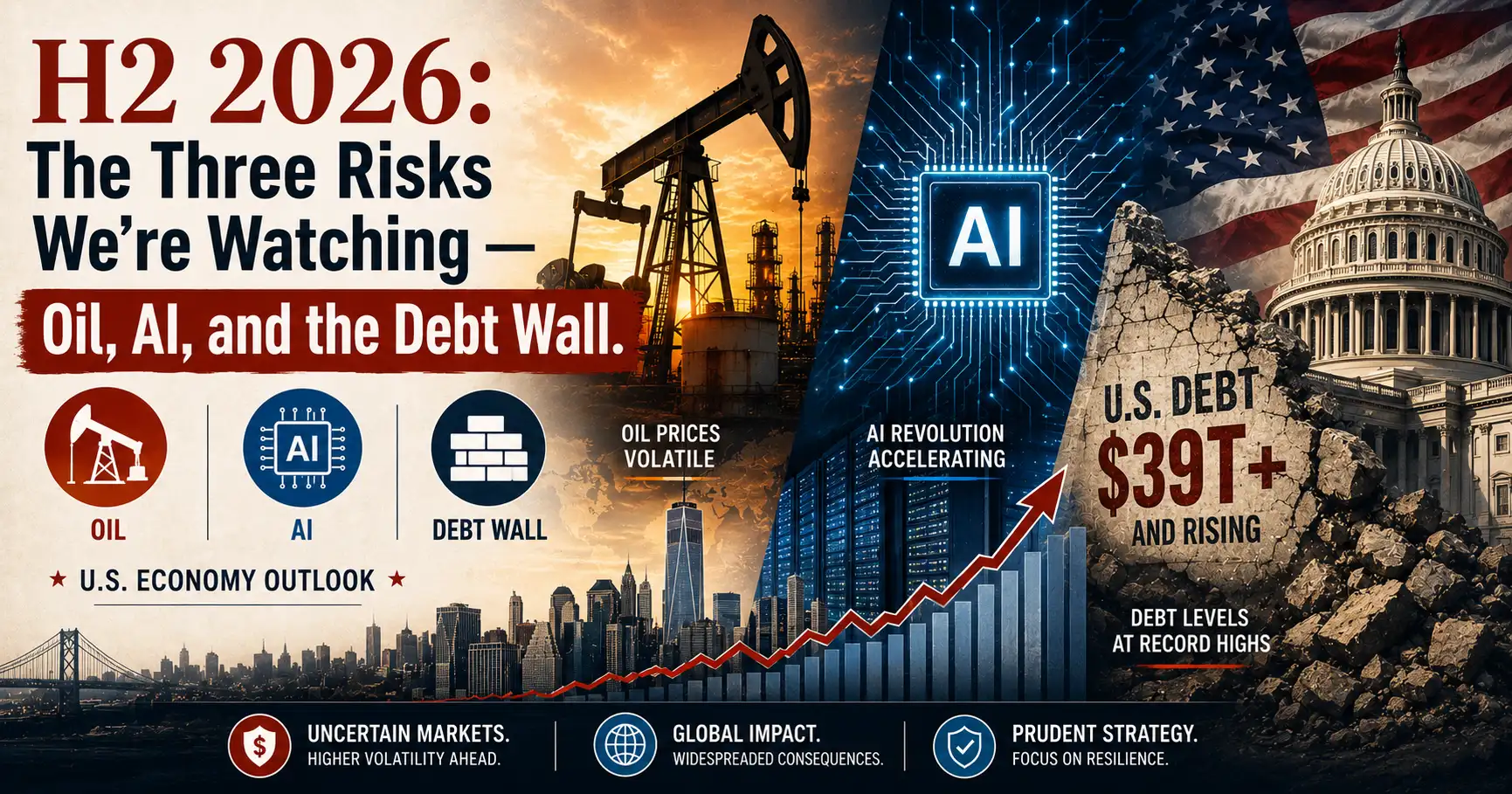
Three forces will shape markets into year-end: a depleted oil market, an AI boom built on concentrated bets, and a $40T debt wall. Our read on how they link.
Three risks will set the tone for markets into year-end — oil, artificial intelligence, and the wall of government debt. They are usually discussed in three separate rooms. This brief argues they are the same story, told in three accents, and the accent they share is the price of money.
Every quarter, we step back from the individual stories and ask a single question: if you could only watch three things for the next six months, what would they be? For the second half of 2026, the answer is unusually clean. One sits in the physical world (a barrel of crude), one in the digital (a graphics chip), and one in the financial plumbing (a Treasury bond). On the surface, they have nothing to do with each other.
They have everything to do with each other. Each of the three is, at its core, a bet on the cost and availability of capital — on interest rates, liquidity, and the willingness of lenders to keep extending credit at today's prices. Pull that one thread and all three move together. That is the edge in this brief: the market is pricing these as independent risks. We think they are correlated, and correlation is exactly what a portfolio built for three separate problems is least prepared for.
- Oil has no margin of safety left. Crude round-tripped a war — from roughly $150 toward $73 — while the buffers that absorb the next shock were drawn down to multi-decade lows. The price fell; the fragility did not.
- The AI boom is real but concentrated. NVIDIA's $81.6 billion quarter proves the demand is genuine. It also means an enormous share of market value now rests on a single capital-spending cycle continuing uninterrupted.
- The debt wall is a refinancing problem, not a default one. The danger in a $39-trillion-plus debt load is not that America fails to pay — it is the rate at which trillions must be rolled over, and what that does to every other yield.
- The hidden link is rates. Cheap money inflates all three; a higher-for-longer world deflates all three at once. They are one risk wearing three masks.
- Our base case is uneasy stability — but the tail we respect most is a liquidity event, because that is the scenario in which the three risks stop being independent and start reinforcing one another.
Below, each number is anchored to research we have already published — follow the links for the full evidence. The forward-looking judgments are explicitly our own, and explicitly uncertain.
- Spare capacity
- Oil production that can be switched on quickly and held there — the market's shock absorber. When it is near zero, a supply scare becomes a supply shortage.
- AI capex cycle
- The wave of capital spending by large technology firms on data centres and chips. It is the demand that drives NVIDIA's revenue — and it can slow as fast as it accelerated.
- Refinancing wall
- The schedule on which existing debt matures and must be re-borrowed. If it is rolled over at higher interest rates than it was issued, the cost rises even if the debt does not.
- Term premium
- The extra yield investors demand to hold longer-dated bonds. When it rises, every long-term borrowing cost in the economy — mortgages, corporate debt — tends to rise with it.
Risk One — Oil: A Market With No Margin of Safety
The first risk is the easiest to misread, because the price is telling a reassuring story. Crude has surrendered almost the entire risk premium it built during the Middle East conflict of early 2026, sliding from physical levels near $150 a barrel back toward the low $70s. The tape reads like an all-clear.
It is not. As we documented in detail in our investigation into the 2026 crude repricing, the fall was driven as much by forced selling and a 2027-surplus narrative as by any genuine resolution of the underlying conflict — and it happened while the world drew its emergency buffers down to the thinnest levels in a generation. OPEC+ effective spare capacity collapsed to roughly 320,000 barrels a day, and inventories fell toward levels last seen two decades ago. The premium left the price; the fragility stayed in the system.
For a US investor, this is not abstract. A coiled oil market is an inflation risk hiding in plain sight: a sudden spike feeds straight into headline inflation and, through it, into how much room the Federal Reserve has to cut rates — which is exactly where this brief's third risk lives. A market with no spare capacity makes that spike more violent, not less, and ties the price of a barrel directly to the price of money.
Watch the buffer, not the price. A cheap barrel sitting on top of empty storage and zero spare capacity is not a calm market — it is a coiled one. The next disruption, whenever it comes, lands on a system with nothing held in reserve, which is precisely how a price shock becomes a volume shock.
For H2, we treat oil as a low-probability, high-severity risk: unlikely to dominate a quiet month, capable of dominating every month if Hormuz flares again.
Risk Two — AI: A Boom Built on Concentrated Bets
The second risk is the opposite shape: not a quiet danger but a loud success that has quietly become a concentration. The demand is unmistakably real. NVIDIA's $81.6 billion quarter — with data-centre revenue around $75 billion and a Q2 outlook near $91 billion — is not a bubble talking. It is a build-out, and Jensen Huang's line that "agentic AI has arrived" reflects genuine, paid-for demand from the largest technology firms on earth.
The risk is not that the demand is fake. It is that so much of the market's total value now leans on one capital-spending cycle staying uninterrupted — and that cycle has two pressure points we have already mapped. The first is geopolitics: the export-control exposure that puts a politically controlled ceiling on one of the largest end-markets. The second is the nature of capex itself — it is a decision, renewed each quarter, not an annuity. A handful of hyperscalers can slow their spending far faster than they ramped it.
When a small number of companies drive a large share of an index's gains, the index inherits their single points of failure. You can be completely right that AI is transformative and still be exposed if the spending that funds it pauses for a quarter — because the valuations have been priced as if it never will.
We are bullish on the technology and mindful of the concentration. The single highest-signal number for H2 is not NVIDIA's revenue — it is the forward capex guidance of its largest customers. As long as the hyperscalers keep raising their spending plans, the cycle is intact. The quarter the language shifts from "raising" to "digesting" is the quarter this risk moves from the back of the brief to the front.
Risk Three — The Debt Wall: When Refinancing Meets Reality
The third risk is the one that connects the other two, and the one most often misframed. The fear that gets attention is default — the question of whether America can "go bankrupt." As we argued in Can America Afford $40 Trillion in Debt?, that is the wrong worry. A government that borrows in its own currency does not run out of dollars. The real pressure is mechanical: an enormous stock of debt, much of it short-dated, must be continually rolled over — and the rate at which it is refinanced is no longer the near-zero rate of the last cycle.
That is the refinancing wall. Rolling trillions from low-rate vintages into higher-rate ones lifts interest costs even if not a single new dollar is borrowed, and a rising term premium pushes up the yield on everything priced off government bonds. The transmission does not stop at Washington. It runs into every mortgage, car loan and corporate refinancing in the country. American households feel it directly: mortgage rates, auto loans and credit-card balances all reset to the new, higher cost of money, and the strain tends to surface in rising delinquency rates well before it surfaces in the federal budget.
The debt wall is not an event with a date; it is a tide. It rises quietly, through auction after auction, until a weak Treasury sale or a jump in the term premium makes it suddenly visible. We watch the plumbing — auction demand and the long end of the curve — not the debt-clock headline, because the headline has been frightening and irrelevant for years while the plumbing is where the actual stress will first appear.
The Through-Line: How the Three Connect
Now assemble the pieces, because the assembly is the whole point. Each risk, traced to its root, ends at the same place: the price of money.
Cheap, abundant capital is what let the AI capex cycle run at full speed, what kept the cost of carrying a record debt load tolerable, and what underwrote the leverage that swings the oil market around. It is also what produces records like the $85.7 billion SpaceX listing — the largest IPO in history and a clean read on how much risk appetite cheap money manufactures. A world of higher-for-longer rates pressures all of it simultaneously — it raises the hurdle for capex, lifts the cost of refinancing the debt, tightens the financial conditions that govern commodity leverage, and drains the appetite that floats richly priced new issues.
These are not three risks. They are one risk — the cost of money — observed in three different markets.
That is why the correlation matters more than any single story. A portfolio can be hedged against an oil spike, or an AI drawdown, or a bond-market wobble, in isolation. What it is rarely hedged against is all three arriving together because the thing underneath them moved. The comfort of treating them as separate is exactly the vulnerability. If rates surprise to the upside, the diversification investors think they own — energy here, technology there, bonds for safety — quietly converges into the same trade.
Three Scenarios for H2 2026
Forecasting a single outcome into this would be false precision. Far more useful is to frame the distribution, attach rough and openly subjective probabilities, and let you weigh the path that seems most credible. These are scenario sketches — our analysis, not consensus, and not advice.
Treat each percentage as an honest best guess at the odds, the way a forecaster says "60% chance of rain" — a guide to planning, not a certainty. The probabilities are deliberately round, and they do not sum to exactly 100% because the scenarios are not perfectly exclusive.
Rates drift sideways, the AI capex cycle keeps grinding higher, oil stays range-bound on a soft demand outlook, and the debt wall is refinanced without a scare. Markets climb a wall of worry. It is the most likely single path — but it is "stability" resting on thin buffers, so it is calm, not safe.
Inflation proves stickier than hoped and rates stay higher for longer. The AI leaders hold up but the rest of the market struggles under heavier discount rates; refinancing costs grind upward; consumer credit stress widens. No crash — just a slow tightening that rewards quality and punishes leverage and long-duration bets.
The tail we respect most — the one where the three risks stop being independent. A Hormuz disruption, a hyperscaler capex pause, or a failed Treasury auction transmits through rates and liquidity into the other two. This is the scenario in which "diversified" portfolios discover they were concentrated all along. Low probability; high severity; the one worth a hedge.
Probabilities are the author's subjective estimates for framing only, not statistical forecasts.
What We're Watching
Headlines will mislead. These six readouts will not — each is a direct gauge of whether the risks are staying dormant or starting to converge.
- The long end of the Treasury curve and the term premium. The single highest-signal series, because it sits underneath all three risks. A rising term premium is the tide coming in.
- Hyperscaler capex guidance and NVIDIA's next quarter. The roughly $91 billion outlook is the bar. Watch whether the largest customers keep raising spending plans — the moment they pause, the AI risk reprices.
- Oil's buffers, not its price. Spare capacity, inventory days-of-cover, and any return of war-risk insurance premiums around Hormuz. The price can lie; the buffer cannot.
- Treasury auction demand. Bid-to-cover ratios and the share taken by dealers. A weak auction is how the debt wall becomes visible all at once.
- Credit spreads and consumer delinquencies. Where higher-for-longer shows up first in the real economy. We have already documented the mechanics of this in Canada's mortgage-renewal wall — a useful preview of how a reset shock moves through household balance sheets, even though the US market's longer fixed-rate structure means the same pressure builds more slowly here.
- China and export-control escalation. The political ceiling on the AI end-market, and a swing factor for both technology supply chains and energy demand.
The Bottom Line
The market is watching oil, AI, and the debt wall as three separate weather systems. Our read is that they share a barometer — the price of money — and that the most underpriced risk of the second half is not any one of them failing, but the chance that they move together. The base case is still an uneasy calm. The discipline is to hold that base case while respecting the tail, and to watch the one variable that turns three manageable risks into a single unmanageable one.
The job for H2 is not to predict which risk breaks. It is to notice that they are wired to the same switch.
Frequently Asked Questions
What are the three biggest market risks for the second half of 2026?
In our assessment: oil (a market with record-low spare capacity and depleted inventories, so any disruption is amplified), artificial intelligence (genuine demand but extreme concentration of market value in a single capital-spending cycle), and the government debt wall (the cost of refinancing a $39-trillion-plus debt load at higher interest rates). We see them as linked by a single factor — the cost of money.
Why would these three risks be connected?
Each one is ultimately a bet on interest rates and liquidity. Cheap capital inflated all three — it funded the AI build-out, kept the debt affordable to carry, and underwrote leverage in commodities. A higher-for-longer rate environment pressures all three at the same time, which is why a portfolio hedged against them individually can still be caught if rates move.
Is the AI boom a bubble?
The demand is real — NVIDIA's $81.6 billion quarter reflects paid-for spending by the largest technology firms, not speculation. The risk is concentration and durability: a large share of market value now depends on the AI capital-spending cycle continuing uninterrupted, and that spending is a quarterly decision that can slow quickly. Watch the customers' capex guidance, not just the chipmaker's revenue.
Can the US really run into trouble with $40 trillion in debt?
Not in the way most people fear. A government that borrows in its own currency does not run out of dollars, so outright default is not the base case. The real pressure is refinancing — rolling trillions of short-dated debt over at higher rates raises interest costs and can lift yields across the economy. The stress, if it comes, shows up first in Treasury auctions and the long end of the curve, not in a missed payment.
Is this article investment advice?
No. It is an analytical framework for thinking about risk, not a recommendation to buy or sell any security or commodity. The scenarios and probabilities are the author's subjective analysis. Do your own due diligence and consult a qualified financial adviser before making any investment decision.
This Intelligence Brief is a synthesis of research The Intelligence Edge Research has already published; every figure cited links to the underlying article, where the primary sources are documented in full. Forward-looking judgments and scenario probabilities are clearly labelled as the author's subjective analysis. Figures are current as of publication. It draws on our prior work on:
- The 2026 oil repricing — spare capacity, inventories, and the collapse of the wartime risk premium.
- NVIDIA's Q1 FY2027 results — revenue, data-centre demand, and forward outlook.
- NVIDIA's China export-control exposure — the political ceiling on the AI end-market.
- The US federal debt load — ownership, refinancing dynamics, and what actually constitutes the risk.
- The SpaceX IPO — a marker of risk appetite and the liquidity that cheap money manufactures.
- Canada's mortgage-renewal wall — a comparative case study in how higher-for-longer reaches household balance sheets, cited here for mechanism, not as US data.
This synthesis reflects the connections we draw between those stories; the responsibility for that interpretation is ours.
This article is for educational and informational purposes only and is not investment advice; do your own due diligence and consult a qualified financial advisor before making any investment decision.